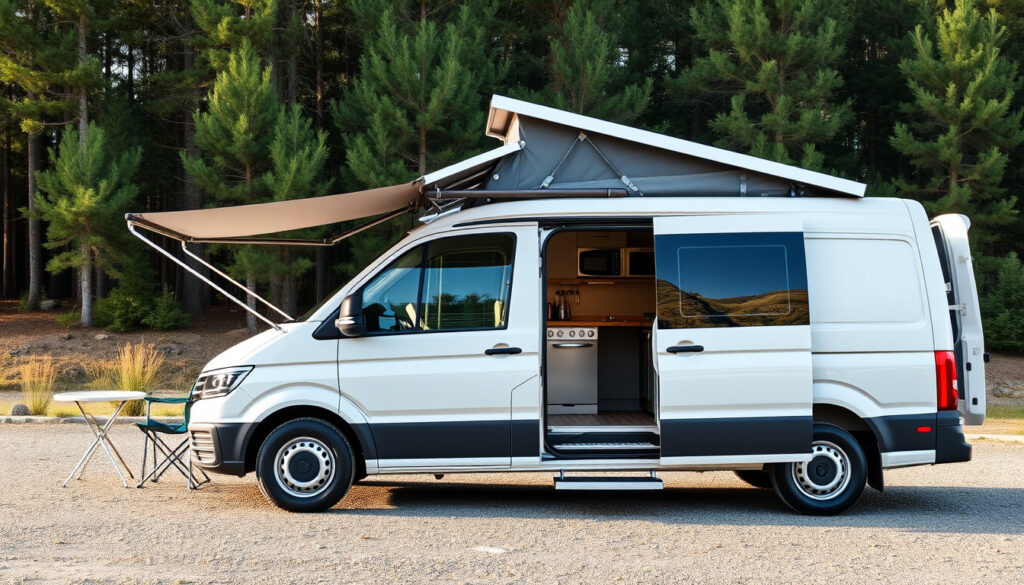
Volkswagen Crafter – Complete Campervan Conversion Guide
What is the price of a VW Crafter in the UK, and how much does a campervan conversion cost?
Volkswagen’s Crafter panel van range starts at roughly £38,570 ex-VAT, which works out to about £46,204 OTR including VAT for the 2025 model year. That entry point applies to the shorter MWB body with a standard roof, and it climbs steadily as you add length, roof height, and drivetrain options. Independent market sources put the broader new-car spread at around £37,315 to £56,438 ex-VAT, depending on trim and specification.
For buyers looking at used stock, the picture is noticeably cheaper. Autotrader listings from 2025 show examples starting from £25,885 +VAT and £27,995 +VAT, while PistonHeads listed similar 2025 vans from about £31,989 +VAT. Nearly-new vehicles with mileage in the low thousands are also available on marketplaces like Cazoo, which confirms that the used market has real depth for conversion projects.
What exactly is included in the base price?
The base Crafter is a rear-wheel-drive panel van with a 2.0 TDI diesel engine, a six-speed manual gearbox, and a basic trim level. It comes with steel wheels, manual air conditioning, and a basic infotainment screen. At the entry price you are not getting a high roof or 4MOTION all-wheel drive, so the headline figure is really the starting point rather than a typical conversion donor.
Most campervan builders opt for the high-roof LWB version, which pushes the price up. The difference between a base MWB and a high-roof LWB can be several thousand pounds, and that gap widens if you choose the 4MOTION all-wheel-drive system. These options are worth understanding before you commit, because they directly affect both the purchase price and the interior height available for your build.
How much does a full campervan conversion add on top?
The van itself is only part of the total cost. A professional conversion on a Crafter typically adds anywhere from £15,000 to £30,000 depending on the fit-out level. That covers insulation, a kitchen unit, a rock-and-roll bed, leisure electrics, and usually a pop-top or fixed high roof if you started with a standard panel van.
DIY conversions are significantly cheaper, but they come with their own costs in time and materials. A complete self-build on a Crafter can be done for £8,000 to £15,000 in parts and materials, though that figure depends heavily on the quality of the appliances, the battery system, and whether you do the work yourself or pay a specialist for the finishing touches.
Insurance and registration costs also vary, so it is worth spreading the shell price and the conversion cost over the full ownership picture before you start. The Crafter’s wide payload range means some versions are much better suited to heavier self-builds than others, which is why the choice of base van matters as much as the conversion itself.
When comparing the Crafter with a Mercedes Sprinter, the VW generally starts at a lower entry price. One 2025 UK comparison put the Crafter around £38k ex-VAT versus roughly £43k ex-VAT for a base Sprinter panel van. That gap narrows when you add options, so the final price depends heavily on the specification you choose.
For most buyers, the LWB high-roof Crafter is the most practical sweet spot. It gives you a 4.3-metre load length and 1,961 mm of internal height, which is enough for standing room and a functional living space. The LWB Maxi stretches the load bay to 4,855 mm, but this longer body can make parking and manoeuvring harder in urban areas.
If all-wheel drive is a priority, the 4MOTION system is available on select panel van configurations, including the 2.0 TDI 177PS with the 8-speed automatic gearbox. However, VW notes that 4MOTION and RWD derivatives lose 100 mm of internal load height because the floor is raised. This trade-off matters if you find yourself working in a space with limited headroom.
The super-high roof option takes the interior height to 2,196 mm, which is generous for most people over six feet tall. But again, this is only available on select body lengths, and it adds to both the purchase price and the overall height of the van, which can be a factor if you plan to use ferry routes or low bridges.
What are the key dimensions and payload figures for the VW Crafter?
Volkswagen offers the Crafter in three main body lengths: MWB, LWB, and LWB Maxi. The exterior length ranges from 5,986 mm on the MWB up to 7,391 mm on the LWB Maxi. Load length follows the same pattern, starting at 3,450 mm and extending to 4,855 mm on the longest body.
The exterior height depends on the roof option, with three choices available. The standard roof comes in at 2,355 mm, the high roof at 2,590 mm, and the super-high roof at 2,798 mm. Interior loading height mirrors these figures, ranging from 1,726 mm on the standard roof up to 2,196 mm on the super-high roof.
| Spec | MWB | LWB | LWB Maxi |
|---|---|---|---|
| Overall length | 5,986 mm | 6,836 mm | 7,391 mm |
| Load length | 3,450 mm | 4,300 mm | 4,855 mm |
| Exterior height (std/high/super-high) | 2,355 / 2,590 / 2,798 mm | same | same |
| Interior loading height (std/high/super-high) | 1,726 / 1,961 / 2,196 mm | same | same |
| Maximum load width | 1,832 mm | same | same |
| Width between wheelarches | 1,380 mm | same | same |
Payload is where the Crafter really spreads its wings. VW UK lists the range from 728 kg up to 2,573 kg, depending on configuration. Independent reviews reference a typical gross payload of around 1,162 kg for a specific UK trim, while camper-conversion listings commonly mention payloads of about 1,400 kg for suitable conversion bases.
For campervan buyers, payload matters because the finished build, passengers, water, fuel, and accessories all count against it. The Crafter’s large range means some versions are much better suited to heavier self-builds than others. A simple two-person camper might only need 1,200 kg, but a full four-berth with a shower and large water tanks could push past that.
How do the roof options affect interior space?
The high-roof Crafter offers 1,961 mm internal height, which is enough for most adults to stand upright comfortably. The super-high roof takes that to 2,196 mm, giving extra headroom and better airflow above the bed area. Both options are popular with converters, and the choice often comes down to external height restrictions.
On 4MOTION and RWD derivatives, the internal load height drops by 100 mm because the floor is raised to accommodate the drive system. This is a critical detail for anyone planning to fit a fixed bed or a shower cubicle, where every centimetre of headroom counts.
Choosing 4MOTION gives you all-weather traction but costs you 100 mm of interior height. If standing room is a priority, a standard RWD or FWD Crafter with a high roof is often the better choice. Weigh the winter benefits against the daily living space before you commit.
The load width is another strong point. The maximum load width is 1,832 mm, and the space between the wheelarches is 1,380 mm. This is wide enough for standard kitchen units and bed frames, and it makes the Crafter one of the more flexible bases on the market for a self-build layout.
How does the VW Crafter compare with the Mercedes Sprinter for camper conversions?
Both the Crafter and the Sprinter are excellent large-van bases, but they have different strengths. The Crafter generally has a lower entry price, while the Sprinter tends to hold its value slightly better and offers a wider range of high-performance engines. In day-to-day driving, the Crafter is often praised for its ride quality and build finish.
For conversion work, the key differences are height, payload, and all-wheel-drive availability. The Crafter’s high roof gives 1,961 mm interior height, while the Sprinter’s high roof is slightly taller at around 1,985 mm. In the super-high realm, the Crafter reaches 2,196 mm, which is comparable to the Sprinter’s tallest roof option.
When it comes to payload, both vans offer heavy-duty variants, but the Crafter’s range is slightly wider at the top end. The 2,573 kg maximum payload on the Crafter is a genuine advantage for anyone planning a large freshwater tank or a full-size kitchen. The Sprinter, however, offers more engine choices, including a more powerful six-cylinder diesel in some markets.
Which is better for a self-build campervan?
The answer depends on your priorities. If you want maximum interior length and height for the lowest price, the Crafter is the stronger candidate. Its LWB Maxi body with a super-high roof gives you 4,855 mm of load length and 2,196 mm of headroom, and it costs less than a comparable Sprinter LWB.
If you need all-wheel drive, the Crafter’s 4MOTION system is well regarded, but it costs you 100 mm of interior height. The Sprinter’s 4×4 system has the same trade-off, so there is no clear winner there. The real difference is price, and the Crafter comes out ahead in the entry-level AWD market.
For winter use and muddy campsite approaches, both systems are effective. The choice often comes down to dealer network and personal preference. Volkswagen’s UK dealer coverage is strong, but Mercedes has a wider commercial vehicle network in some rural areas, which can be a factor if you plan to travel extensively.
There is no definitive answer for which van is better, because it depends on your layout, budget, and driving habits. The Crafter offers better value for money in standard form, while the Sprinter has a slight edge in outright capability at the top end. Either base will produce a reliable, comfortable campervan.
Is the VW Crafter a reliable motorhome base?
Reliability is a strong point for the Crafter, but it is not without its quirks. The 2.0 TDI engine is a well-known unit that is shared across the VW Group, and it has a generally good reputation. That said, some owners report issues with the diesel particulate filter (DPF) and the AdBlue system, particularly on vans that are used for short trips rather than long motorway journeys.
Overall satisfaction remains high, especially among campervan owners who value the driving experience and the build quality. The Crafter handles well for its size, and the cabin is noticeably more car-like than older commercial vans. This makes long journeys more comfortable, which is a real benefit for a motorhome.
One thing to watch is the service history. The Crafter has a cambelt replacement interval that varies by engine, and skipping it can lead to serious engine damage. A full service record with evidence of the cambelt change is worth looking for when you are buying a used example.
What common issues should buyers look for?
The most frequently mentioned problems are DPF blockages and AdBlue faults. Both are emissions-related and can be triggered by stop-start city driving. If you are buying used, check the service history for evidence of regular long runs, and ask whether the AdBlue system has ever required repairs.
Other less common but still reported issues include suspension wear and electrical glitches, though these tend to be isolated rather than widespread. The general consensus among owners and reviewers is that the Crafter is a dependable workhorse, provided it is maintained properly.
“The Crafter is a refined and well-built large van, with a comfortable ride and a strong list of standard equipment.” — WhatVan? Review
It is worth noting that reliability can vary by model year and engine choice. The 2.0 TDI 177PS unit is generally considered the sweet spot for performance and efficiency, and it is the most common engine in the used market. The 140PS version is adequate but can feel underpowered when fully loaded.
Can you convert a VW Crafter into a motorhome without specialist help?
Yes, but it requires careful planning and a reasonable level of DIY skill. The Crafter is a popular base for self-builds because its rectangular load bay makes cutting and fitting straightforward. The main challenges are wiring the leisure electrics, insulating the panels properly, and ensuring that the finished weight stays within the payload limit.
A complete self-build typically takes three to six months of part-time work, depending on your experience and the complexity of the design. Many first-time builders start with a simpler layout and upgrade later. The key is to plan the plumbing and electrics before you start cutting holes in the bodywork.
If you prefer a professional finish but want to save money, a semi-conversion is another option. You can buy a bare shell, have a specialist fit the insulation and wiring, and then build the furniture yourself. This approach reduces the risk of major mistakes while still giving you control over the final layout.
What do you need to know before starting a conversion?
The first step is to choose the right base van. The LWB high-roof Crafter is the most popular choice for camper conversions because it offers a good balance of length, height, and payload. The LWB Maxi adds more length but can be harder to park and manoeuvre.
You also need to think about weight. The finished camper needs to stay under the vehicle’s gross vehicle weight (GVW), which varies by spec. A typical conversion with water tanks, a kitchen, and two people can easily add 800 kg, so it is worth starting with a van that has a payload of at least 1,300 kg.
There is no legal need to have a professional conversion certified unless you are planning to register the vehicle as a motorhome for tax or insurance purposes. In that case, you will need a declaration from a specialist or a DVLA inspection. It is best to check the current rules with the DVLA before you start.
What is the history of the VW Crafter?
Volkswagen introduced the Crafter in 2006, replacing the long-running LT series. It was jointly developed with Mercedes-Benz, and early models shared their underpinnings with the Sprinter. This partnership meant that the first-generation Crafter and Sprinter were mechanically very similar, though they had different styling and interior trim.
The second-generation Crafter arrived in 2017, and it was a clean-sheet design that moved away from the Sprinter platform. This version introduced a more modern cab, a wider range of driver assistance systems, and a choice of front, rear, or all-wheel drive. It also brought the 4MOTION system to the range for the first time.
In 2025, the Crafter remains on sale with a range of 2.0 TDI diesel engines, though VW has confirmed that an all-electric successor is under development. The e-Crafter was first shown as a concept in 2018, and a limited production version has been sold in some markets, but full availability is still uncertain.
What might the next generation look like?
An all-electric e-Crafter successor is the most likely next step, and VW has hinted that it will share technology with the ID. Buzz and other electric commercial vehicles. The exact launch date and UK availability are not yet confirmed, and VW has made no official announcement beyond confirming that the model is in development.
2025 updates may also bring advanced driver assistance systems (ADAS), such as adaptive cruise control and lane-keeping assist, as standard on more trims. These features are already available on higher-spec models, and they are likely to become more common as the range moves closer to the electric transition.
For now, the diesel Crafter remains the mainstream choice, and the used market is well supplied with both panel vans and camper conversions. If you are not in a hurry, waiting for the electric version might make sense, but it is unclear when it will arrive in meaningful numbers in the UK.
Which Volkswagen Crafter is best for a campervan conversion?
For most builders, the LWB high-roof Crafter is the best overall choice. It offers a 4.3-metre load length and 1,961 mm of interior height, which is enough for a two-berth or three-berth layout with standing room. It is also easier to drive than the LWB Maxi and fits into standard parking spaces more easily.
If you need more length for a fixed bed or a garage space, the LWB Maxi with a super-high roof is the most spacious option. It gives you 4,855 mm of load length and 2,196 mm of headroom, and it is still manageable on UK roads. The main downside is the extra cost and the slightly larger turning circle.
For all-weather capability, the 4MOTION version is worth considering, but only if you are happy to lose 100 mm of interior height. A high-roof 4MOTION Crafter offers 1,861 mm of headroom, which is still enough for most people, but it is a real consideration for taller individuals.
Best-use length: LWB or LWB Maxi. Best roof for standing room: high roof or super-high roof. Maximum interior height: 2,196 mm on the super-high roof, but 100 mm less on 4MOTION/RWD versions.
Payload is another key factor. A conversion-friendly Crafter typically has a payload of around 1,200–1,400 kg, though the official VW payload varies widely by spec. If you plan to carry a large water tank, heavy batteries, or a full-size kitchen, aim for a van with a payload closer to the 1,400 kg mark.
Used 2025 examples start from roughly £25.9k +VAT for van-only vehicles, with higher prices for better-specced or low-mileage models. The premium for a 4MOTION version is usually around £3,000–£5,000 over a comparable RWD model, which is worth factoring into your budget.
How does the Crafter perform in day-to-day driving?
The Crafter is known for its car-like ride quality and refined diesel engines. The 2.0 TDI units range from 140PS to 177PS, and the more powerful versions feel strong even when the van is loaded. The 8-speed automatic transmission is a popular option and pairs well with the 4MOTION system.
Fuel economy varies by spec and load, but typical figures are in the 28–34 mpg range for mixed driving. The 177PS engine is the most efficient in real-world conditions because it does not need to work as hard to maintain speed. On a motorway run, 30+ mpg is achievable with a moderate load.
Noise levels are well controlled for a van of this size, and the cabin is comfortable for long distances. The Crafter feels stable at high speeds and copes well with crosswinds, which is a benefit for camper conversions that are taller and heavier than standard panel vans.
What are the main options worth adding?
4MOTION all-wheel drive is the headline option for anyone planning winter travel or rough campsite tracks. It adds a few thousand pounds to the price, but it also increases the van’s capability significantly. The trade-off is the reduced interior height and a slight fuel economy penalty.
Other worthwhile options include a reversing camera, which is very helpful in a van of this size, and a tow bar for carrying bikes or a small trailer. The Crafter can tow up to 3,500 kg when properly specified, which is plenty for a small car or a trailer full of camping gear.
What do current owners say about the Crafter?
Owner reviews are largely positive, with the most common praise focused on the driving experience, build quality, and practical load space. Many campervan owners mention that the Crafter is significantly more pleasant to drive than a typical large van, and that the high roof makes a huge difference to the sense of space inside.
The main criticisms are the DPF and AdBlue issues, which are more common on vans used for short trips, and the cost of some replacement parts. A few owners also note that the infotainment system in older models can be slow, though this is not a widespread complaint.
“I’ve had my Crafter camper for two years and 30,000 miles. It’s been reliable, comfortable, and surprisingly economical. The high roof is the best option I chose.” — Owner review on a UK campervan forum
For anyone planning a full-time or frequent camper conversion, the Crafter is a solid, trusted choice. Its combination of space, payload, and driving comfort is hard to beat in the large-van class.
Frequently Asked Questions
Does the VW Crafter come with 4MOTION all-wheel drive?
Yes, 4MOTION is available on select panel van configurations, including the 2.0 TDI 177PS with the 8-speed automatic gearbox. It is ideal for off-road or winter conditions, but it reduces interior load height by 100 mm.
What is the best engine for a Crafter campervan?
The 2.0 TDI 177PS is the most popular choice for campers. It offers strong performance and good fuel economy, and it copes well with the extra weight of a conversion. The 140PS version is adequate but can feel underpowered when fully loaded.
How much does a used 2025 Crafter cost in the UK?
Used 2025 examples start from around £25,885 +VAT on Autotrader and £31,989 +VAT on PistonHeads. Prices vary by trim, mileage, and whether the van has a high roof or 4MOTION.
What is the maximum interior height of the Crafter?
The super-high roof offers 2,196 mm of interior loading height. The high roof offers 1,961 mm, and the standard roof is 1,726 mm. On 4MOTION/RWD versions, all heights are reduced by 100 mm.
Can you convert a Crafter into a camper without professional help?
Yes, many owners complete DIY conversions successfully. The main challenges are wiring the leisure electrics, insulating properly, and staying within the payload limit. Professional help is only required for DVLA motorhome registration in specific cases.
What are the most common problems with the VW Crafter?
The most common issues are DPF blockages and AdBlue system problems, usually on vans used for short trips. Overall satisfaction is high, and most owners report strong reliability when the van is maintained properly.
Is the Crafter better than the Sprinter for a camper?
There is no clear winner. The Crafter offers better value in standard form and a wider payload range at the top end. The Sprinter has a slightly more premium feel and more engine choices, but it costs more initially.
What is the towing capacity of a Crafter?
The Crafter can tow up to 3,500 kg when properly specified. This makes it possible to tow a small car, a trailer, or a large trailer full of camping equipment, which is a useful option for extended trips.
More related posts
 How Old Is Jane McDonald – Age, Biography and Family Facts
 Sarah Pochin – Biography, Family, and Political Career
 Heidi Klum – Net Worth, Husband, Children and Career in 2025
 Edward Teach – The Real Pirate Behind Blackbeard Legend
 Dizzee Rascal – Grime Pioneer, MBE, and 2026 Comeback
 Paula Yates – Biography, Death, and Her Children’s Tragic Story
 Sarah Parish – Biography, Family, Health, Career
 Jeremy Irons – Biography, Movies, Net Worth & Castle (2025)