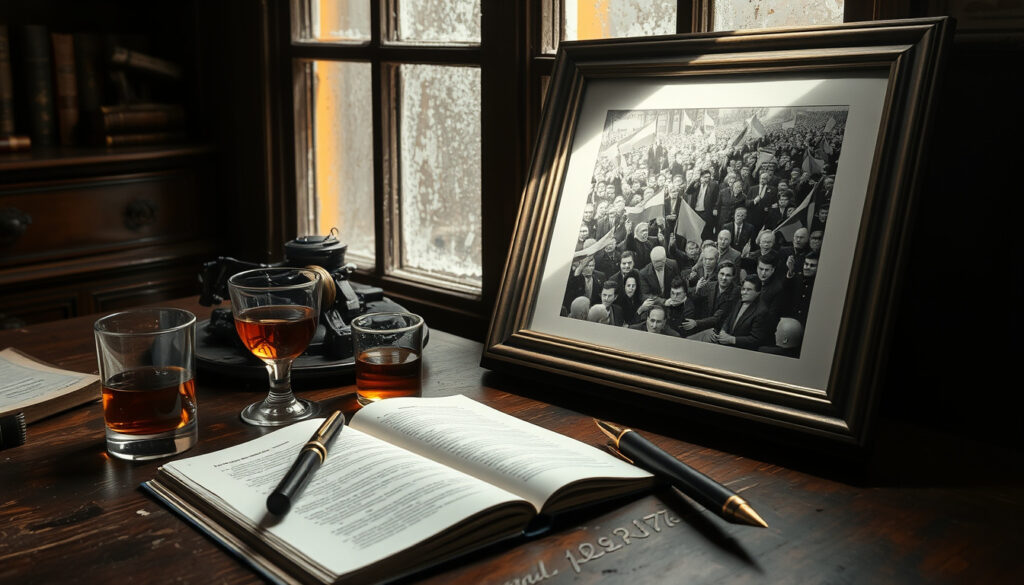
Leon Trotsky – Revolutionary Leader, Exile and Assassination
Leon Trotsky was a leading Bolshevik revolutionary, founder and commander of the Red Army, and one of Joseph Stalin’s fiercest opponents. A major Marxist theorist and organiser, he played a central part in the October Revolution of 1917 and in the early Soviet state. After being expelled from the Soviet Union, he was assassinated in Mexico in 1940 by a Stalin-linked agent (Britannica).
Trotsky’s life passed through several distinct phases: revolutionary youth, military command, political rivalry with Stalin, exile, and finally murder. Each phase shaped the history of communism and the ideological currents that followed him, including the movement known as Trotskyism.
His story is documented across a wide range of sources, though some episodes remain matters of scholarly debate.
How Did Leon Trotsky Die?
On 20 August 1940, Ramón Mercader attacked Trotsky in Coyoacán, in Mexico City. Trotsky was struck in the head with an ice axe and died the next day, 21 August 1940 (Wikipedia). BBC History states that Mercader acted on Stalin’s orders.
The attack brought a dramatic end to an exile that had lasted more than a decade. Trotsky had been living in Mexico since 1937, continuing his political opposition to Stalin and the Soviet bureaucracy. Controversial deaths have a way of keeping public interest alive, as the John McAfee life and death mystery demonstrates.
- Full Name: Lev Davidovich Bronstein (Leon Trotsky)
- Born: 7 November 1879, Yanovka, Russian Empire (now Ukraine)
- Died: 21 August 1940, Coyoacán, Mexico
- Known For: Russian Revolution, Red Army founder, Trotskyism
Key insights into his life include the following:
- Leon Trotsky was a key architect of the October Revolution and the Red Army, but later became Stalin’s main rival.
- He was assassinated with an ice axe in Mexico City by a Stalinist agent.
- Trotsky’s theory of permanent revolution opposed Stalin’s socialism in one country.
- He had a brief relationship with Mexican artist Frida Kahlo while in exile.
- His writings remain influential among Marxist and leftist movements.
- He served as commissar of foreign affairs and commissar of war after 1917.
- In exile, he continued to oppose Stalin and Soviet bureaucracy until his death.
| Field | Details |
|---|---|
| Born | , Yanovka, Russian Empire (now Ukraine) |
| Died | , Coyoacán, Mexico City, Mexico |
| Cause of Death | Assassination (blow to the head with an ice axe) |
| Spouse(s) | Natalia Sedova (m. 1903–1940; his death), Aleksandra Sokolovskaya (m. 1900–1903) |
| Children | Lev Sedov, Sergei Sedov, Zinaida Volkova |
| Religion | Jewish by birth, later atheist / Marxist |
| Political Party | Russian Social Democratic Labour Party (Bolsheviks), Communist Party of the Soviet Union, Fourth International |
| Major Works | The Revolution Betrayed, History of the Russian Revolution, My Life |
What Was Leon Trotsky’s Role in the Russian Revolution?
Trotsky was a central Bolshevik leader during the revolutionary period, widely described as second only to Lenin in the early Soviet state (Biography.com). Britannica identifies him as a communist theorist and agitator who directed Soviet military forces during the revolution and civil war.
He helped lead the October Revolution that brought the Bolsheviks to power, and he later took charge of building the Red Army. His organisational work in 1917 and after made him one of the most visible leaders of the new state.
Where Was Leon Trotsky Born?
He was born Lev Davidovich Bronstein on in Yanovka, then part of the Russian Empire and now in Ukraine. His family was Jewish, and his father is described in sources as a prosperous farmer or well-to-do tenant farmer who later became a landowner (Alpha History). He adopted the name Leon Trotsky later in life.
What Was Trotsky’s Early Life Like?
Political activity marked Trotsky from a young age. He was a key figure in the 1905 Revolution, when he led the St. Petersburg Soviet, and he went on to play a central role in the October Revolution of 1917. Born into a Jewish family, he later embraced a Marxist position and became an atheist.
How Did Trotsky Build the Red Army?
After 1917, Trotsky served as commissar of foreign affairs and then as commissar of war. In that role he organised the Red Army and directed Soviet military forces through the Russian Civil War (Encyclopedia.com).
Trotsky’s wartime role went beyond administration. As commissar of war, he was responsible for forming the Red Army into an effective fighting force and oversaw military operations during the civil war.
What Was the Relationship Between Leon Trotsky, Lenin, and Stalin?
Trotsky joined the Bolsheviks in 1917 and worked alongside Lenin during the revolution. Historians caution, however, that their relationship was not one of complete harmony. The question of whether the two men agreed on all revolutionary strategies is nuanced; some historians emphasise their differences.
What Did Trotsky Think of Stalin?
After Lenin’s death, Trotsky lost the power struggle with Joseph Stalin (BBC History). While in Mexico, he continued his political opposition to Stalin and to the Soviet bureaucracy (EBSCO). The 1940 assassination, carried out by an agent acting on Stalin’s orders, was the final act of that conflict.
What Is Trotskyism?
Trotskyism is the political current that developed around Trotsky’s ideas. Its defining concept was the theory of permanent revolution, which Trotsky developed in opposition to the Stalinist doctrine of “socialism in one country” (YIVO Encyclopedia).
Why Was Trotsky Exiled?
In 1929, after losing the post-Lenin power struggle, Trotsky was expelled from the Soviet Union (Origins). He spent time in Turkey, France, and Norway before seeking asylum in Mexico, where he eventually settled in Coyoacán.
Trotsky and Lenin are often described as revolutionary partners, but historians point out that their views on revolutionary strategy did not always coincide. Later political battles gave those differences additional weight.
What Books Did Leon Trotsky Write?
Trotsky was an extremely prolific writer, producing essays, political tracts, history, memoir, and political theory (YIVO Encyclopedia, Encyclopedia.com). Several of his books were written in exile and remain central to debates about the Soviet Union.
- My Life (1930), his autobiography.
- Permanent Revolution (1931), in which he set out his theory of revolution.
- History of the Russian Revolution (1932–1933), a multi-volume historical account.
- The Revolution Betrayed (1937), a critique of the Soviet Union under Stalin.
- Literature and Revolution, his study of the role of literature in a revolutionary society.
Trotsky’s original texts are available in several digital archives. The Marxists Internet Archive hosts a substantial collection of his books, essays, and speeches.
What Was the Connection Between Leon Trotsky and Frida Kahlo?
During his Mexican exile, Trotsky is historically known to have had a brief relationship with the artist Frida Kahlo. The exact nature of the connection is debated: some accounts describe an affair, while others characterise it as a short-lived friendship.
Trotsky arrived in Mexico in 1937 and lived in Coyoacán with his second wife, Natalia Sedova, who remained with him until his death. He had three children: Lev Sedov, Sergei Sedov, and Zinaida Volkova. His first marriage, to Aleksandra Sokolovskaya, ended in 1903.
What Were the Key Moments in Leon Trotsky’s Life?
The main events of Trotsky’s life are relatively well documented and can be followed chronologically.
- – Born Lev Davidovich Bronstein in Ukraine.
- – Led the St. Petersburg Soviet during the 1905 Revolution.
- – Joined the Bolsheviks and played a key role in the October Revolution.
- – Organised the Red Army and led it during the Russian Civil War.
- – Entered the power struggle after Lenin’s death; lost to Stalin.
- – Exiled from the Soviet Union.
- – Sought asylum in Mexico; lived in Coyoacán.
- – Assassinated by Ramón Mercader, who acted on Stalin’s orders (History.com).
What Is Known and What Remains Unclear About Trotsky’s Life?
| Established information | Information that remains unclear |
|---|---|
| Trotsky was assassinated on in Mexico City. | The exact nature of Trotsky’s relationship with Frida Kahlo is debated: an affair or a brief friendship. |
| The assassin was Ramón Mercader, a Spanish-born NKVD agent. | Some details of his early life, such as the birth date under the Julian and Gregorian calendars, may vary. |
| Trotsky was a leading figure in the Russian Revolution and the founder of the Red Army. | Whether Trotsky and Lenin agreed on all aspects of revolutionary strategy is nuanced; some historians emphasise differences. |
Why Did Trotsky’s Ideas Survive After His Death?
The Russian Revolution of 1917 created a new political order, and the struggle that followed Lenin’s death reshaped it. Stalin’s rise isolated Trotsky, but exile allowed him to continue writing and organising against the Soviet bureaucracy. His critique of that bureaucracy became a reference point for later Marxist debates.
The assassination did not end his influence. Trotskyism survived as a distinct current within Marxism, and Trotsky’s political legacy is associated with the Fourth International. His writings continue to be read by Marxist and leftist movements, keeping his ideas in circulation long after his death.
Which Sources Offer the Most Reliable Information on Leon Trotsky?
Several established reference works document Trotsky’s life and career. Britannica’s biography provides a detailed scholarly overview of his political role, and BBC History maintains a concise profile of his life, death, and place in revolutionary history. The Wikipedia article on Trotsky offers extensive coverage with references to primary and secondary sources.
More detailed academic treatments are available from Encyclopedia.com and the YIVO Encyclopedia, which places Trotsky in the context of Jewish Eastern Europe. EBSCO Research Starters also offers a structured introduction to his political career. For Trotsky’s own words, the Marxists Internet Archive makes a large body of his writings freely available; quotes attributed to him online vary in wording, and the archive makes it possible to check them against the original texts.
What Is Leon Trotsky’s Lasting Significance?
Leon Trotsky remains one of the most studied political figures of the twentieth century. His role in the Russian Revolution, his command of the Red Army, his rivalry with Stalin, and his assassination in Mexico all form part of his legacy. His ideas, especially the theory of permanent revolution and his critique of Soviet bureaucracy, continue to shape Marxist debates, and his books are still reprinted and read. Political biographies such as the Richard Nixon biography show how questions of power and rivalry shape the way public figures are remembered.
Frequently Asked Questions About Leon Trotsky
Was Leon Trotsky married?
Yes. He married twice: first to Aleksandra Sokolovskaya (1900–1903) and then to Natalia Sedova (1903–1940). Sedova remained with him until his death in Mexico.
Did Leon Trotsky have children?
Yes, he had three children: Lev Sedov, Sergei Sedov, and Zinaida Volkova.
What is Leon Trotsky’s most famous book?
His most famous works include The Revolution Betrayed and History of the Russian Revolution. Both were written in exile and present his political analysis of the Soviet Union.
Why was Leon Trotsky exiled?
After losing the power struggle to Stalin, Trotsky was expelled from the Soviet Union in 1929. He lived in exile in Turkey, France, and Norway before finally settling in Mexico.
What is Trotsky’s theory of permanent revolution?
The theory argued that in countries with delayed capitalist development, the bourgeoisie is too weak to lead a democratic revolution, so the proletariat must take power and continue revolutionary transformations internationally.
How old was Leon Trotsky when he died?
He was 60 years old. Born in November 1879, he died on 21 August 1940 in Coyoacán, Mexico.
What was Leon Trotsky’s religion?
He was born into a Jewish family in southern Ukraine, then part of the Russian Empire. Later in life he became an atheist and adhered to Marxism.
When did Leon Trotsky join the Bolsheviks?
He joined the Bolsheviks in 1917, the same year he played a central role in the October Revolution.
More related posts
 Gemma Bissix – Age, Husband, Net Worth and Career
 Oona Chaplin – Biography, Game of Thrones Role and Upcoming Avatar Movie
 Charlton Heston – Biography, Net Worth, and Iconic Movies
 Jing Lusi – Biography, Age, Career, and Movies
 Jodie Marsh – Age, Net Worth, and Fripps Farm Life
 Dominik Mysterio – From Father’s Shadow to WWE Champion
 Linda Kozlowski – Still Alive? Husband, Net Worth, and Life Today
 Sam Sulek – Age, Height, Net Worth and Career 2025