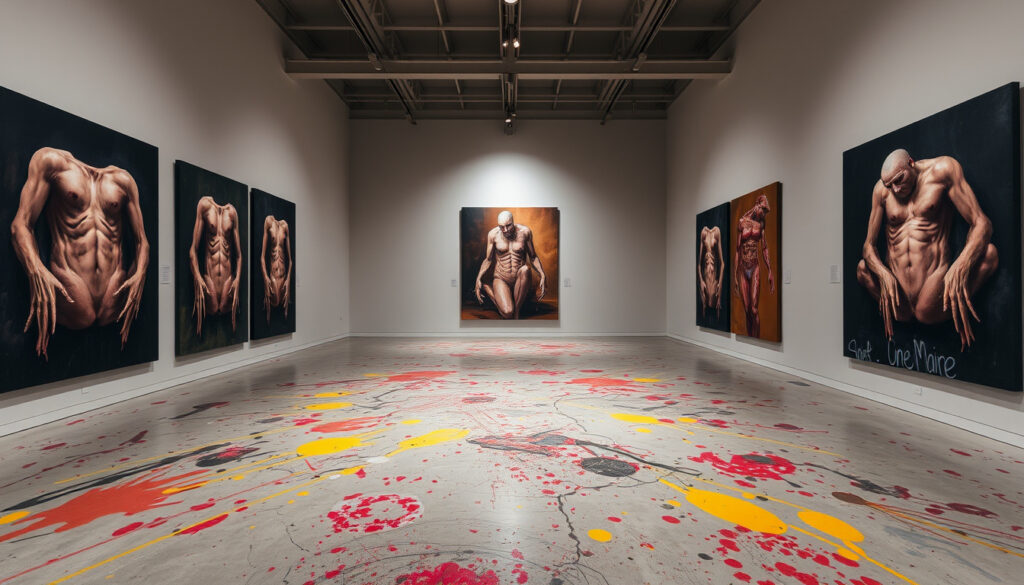
Jenny Saville Artist – Biography, Paintings, and 2025 Exhibition
Jenny Saville is a British figurative painter who emerged as one of the defining voices of her generation. Born in Cambridge in 1970, she became an original member of the Young British Artists (YBAs) while pursuing a path distinctly her own: monumental oil paintings of the female body that refuse to flatter, idealise, or look away. Her work is marked by thick, heavily worked pigment, large-scale canvases, and a deep engagement with flesh, weight, and vulnerability.
Saville’s paintings are not quick reads. They ask the viewer to sit with discomfort, to look at bodies that are often bruised, compressed, or marked by the pressure of living. For decades, critics have debated whether her images critique or reinforce the male gaze. What is not in dispute is her technical command and the lasting influence she has had on contemporary figurative painting.
From her student work Propped, which sold for over $12 million in 2018, to her landmark 2025 retrospective at the National Portrait Gallery, Saville has consistently redefined what it means to paint the human form. This article traces her biography, artistic methods, key works, and the conversations that surround her practice.
Who Is Jenny Saville? Biography and Background
Early Life and Education at Glasgow School of Art
Saville was born in Cambridge and studied at the Glasgow School of Art, graduating in 1992. During her time there she produced the self-portrait Propped, a work that would later define her early career. Some accounts also note a period of study at the University of Cincinnati, though this detail is less frequently cited. She now lives and works in Oxford, England.
Rise to Fame with the Young British Artists (YBAs)
Saville is consistently identified as an original member of the Young British Artists, a loose collective that gained prominence in the late 1980s and 1990s. Unlike many YBAs who worked in installation, video, or conceptual objects, Saville remained committed to representational oil painting. Her inclusion in the landmark Sensation exhibition (1997) placed her work alongside that of Damien Hirst, Tracey Emin, and others, but her approach stood apart for its focus on painterly tradition.
Royal Academy of Arts Membership and Recognition
Saville was elected a Royal Academician, a mark of institutional recognition in Britain. Her profile on the Royal Academy website confirms her membership and lists her among the contemporary artists who have shaped the direction of British painting.
Key Insights
- Jenny Saville is one of the most expensive living female painters, with Propped selling for over £9 million ($12.4–$12.5 million) at auction in 2018.
- Her technique combines photography and painting; she often works from large-scale photographic prints.
- Saville challenges traditional depictions of the female body, focusing on flesh, weight, and vulnerability rather than ideal beauty.
- Her 2025 exhibition at the National Portrait Gallery, The Anatomy of Painting, is the largest UK museum retrospective dedicated to a contemporary painter.
- She draws on references from pathology, surgery, and anatomy to inform the visceral quality of her figures.
- Critics describe her work as renewing the tradition of figural painting by merging figuration with abstraction.
Snapshot Facts
| Attribute | Detail |
|---|---|
| Born | 7 May 1970 |
| Nationality | British |
| Education | Glasgow School of Art (1992) |
| Movement | Young British Artists (YBAs) |
| Gallery Representation | Gagosian |
| Major Work | Propped (1992) |
| Current Exhibition | Jenny Saville: The Anatomy of Painting, National Portrait Gallery, London (2025) |
| Honours | Royal Academician (RA) |
What Type of Artist Is Jenny Saville? Artistic Style and Technique
Figurative Painting and the Human Form
Saville is a figurative painter first and foremost. Her subject is almost always the human body, particularly the female nude, depicted at a scale that forces confrontation. She is widely credited with reinventing figure painting for contemporary art, pulling it away from abstraction and back toward the physical presence of flesh. Her paintings are often described as simultaneously monumental and intimate, and they consistently resist conventional beauty standards.
Use of Oil Paint, Heavy Layers, and Texture
Saville works in oil on large canvases, often six feet or more in height. Her paint handling is distinctive: thick, strongly pigmented layers are pushed, smeared, and scraped across the surface using brushes and extended tools. Small brushstrokes build and soften form, producing a matte finish that does not look dry. The physicality of the paint echoes the physicality of the bodies she depicts.
The Role of Photography and Scale in Her Process
Photography plays a central role in Saville’s process. She frequently works from large-scale photographic prints, using them as a foundation for her paintings. She also draws on imagery related to pathology, surgery, injury, and anatomy, which gives her figures a visceral, almost clinical quality. The combination of photographic source material with heavy oil paint creates a tension between precision and material chaos.
Saville’s method involves building the image through layered strokes and then selectively scraping away paint to reveal what lies beneath. This process of addition and removal creates surfaces that feel alive, as if the body is still forming or dissolving. Critics have compared her handling of paint to the work of Francis Bacon and Lucian Freud, though Saville’s focus on the female body and her use of photographic underpainting distinguish her approach.
What Are Jenny Saville’s Most Famous Paintings? Key Works Explained
Propped (1992): Meaning and Significance
Propped is a self-portrait made while Saville was still a student at the Glasgow School of Art. The painting shows the artist’s body from a low angle, her weight propped on one arm, with text written across the surface. The work became widely famous after selling at auction in 2018 for about $12.4–$12.5 million, setting a record at the time for a living female artist. It is frequently cited as a signature work and a key example of her early approach to body image and self-representation. The meaning of Propped remains open to interpretation: some read it as a feminist reclamation of the nude, while others see it as a critique of the pressure to look at female bodies in certain ways. Saville herself has been deliberately ambiguous on this point.
Other Notable Paintings and the Anatomy of Painting Series
Beyond Propped, several other works are regularly cited in discussions of Saville’s career. Branded (1992) explores marks on the body, both literal and metaphorical. Shift (1997) continues her investigation of flesh and form. Passage (2004) and Shadow Head (2013) show her evolving interest in abstraction and the dissolution of the figure. Her 2025 exhibition at the National Portrait Gallery is titled The Anatomy of Painting, a phrase that captures her lifelong engagement with the structure and materiality of both bodies and paint.
Themes of Body, Identity, and the Gaze
Saville’s work is commonly read through themes of the body, gender, vulnerability, trauma, and materiality. Her paintings do not offer easy answers. They resist the idea of a single, fixed meaning and instead invite multiple readings. This openness has made her work a rich subject for scholarly debate, particularly around questions of the male gaze, female agency, and the politics of representation.
When viewing a Saville painting, note the tension between the monumental scale and the intimate, often uncomfortable proximity to the subject. The figures are not passive; they assert their presence. The heavy paint application and visible brushwork are not just technique—they are part of the meaning, forcing the viewer to reckon with the material reality of flesh.
Where Can I See Jenny Saville’s Paintings? Exhibitions and Galleries
National Portrait Gallery: ‘The Anatomy of Painting’ (2025)
The National Portrait Gallery in London hosts a major retrospective of Saville’s work in 2025 under the title The Anatomy of Painting. This exhibition is described as the largest UK museum retrospective dedicated to a contemporary painter, bringing together works from across her career. The gallery’s dedicated artist entry confirms her place in the British portrait tradition, though specific details of the 2025 exhibition—its exact dates, full contents, and catalogue—are not fully available in public records at the time of writing.
Representation by Gagosian Gallery
Saville is represented by Gagosian Gallery, one of the world’s most prominent commercial galleries. Gagosian’s artist page confirms her continued prominence and notes a 2024 lecture excerpt in which she discussed Cy Twombly and his engagement with time, tension, and growth. The gallery is a primary venue for her recent public profile and for the sale of her works.
Permanent Collections and Other Venues
Saville’s paintings are held in major institutional collections, including the Tate, the National Galleries of Scotland, and the Broad in Los Angeles. Her work is also represented in the Royal Academy’s collection. Because many of her works are held in private collections, the locations of specific paintings are not always publicly listed. For those conducting research, the Gagosian site and the National Portrait Gallery exhibition provide the most accessible starting points for viewing high-quality images of her work.
The exact private collection locations of many of Saville’s works are not publicly listed. This is common for living artists of her stature. Students and researchers should rely on institutional sources—Gagosian, the National Portrait Gallery, the Royal Academy, and the Tate—for verified information about her oeuvre.
What Are the Key Milestones in Jenny Saville’s Career?
- 1992: Graduates from Glasgow School of Art; paints Propped.
- 1992–1993: Included in the early exhibitions that defined the Young British Artists.
- 1997: Featured in the Sensation exhibition at the Royal Academy of Arts, London.
- 1990s–2000s: Gains major gallery representation and rises to international prominence.
- 2018: Propped sells at auction for £9.5 million ($12.4–$12.5 million), setting a record for a living female artist.
- 2025: Major retrospective The Anatomy of Painting opens at the National Portrait Gallery, London.
What Is Known and What Remains Unclear About Jenny Saville’s Work?
| Established Information | Information That Remains Unclear |
|---|---|
| Jenny Saville is an English figurative painter born in 1970. | The critical interpretation of Propped—whether it is about female empowerment or a critique of objectification—remains debated. Saville herself has been ambiguous. |
| She is a member of the Young British Artists and a Royal Academician. | Whether Saville identifies primarily with the YBA label or prefers a separate trajectory is not fully settled in public statements. |
| Her painting Propped (1992) is one of her most famous works. | The exact current private collection locations of many of her works are not publicly listed. |
| She is represented by Gagosian Gallery. | Full details of her 2025 National Portrait Gallery exhibition—its complete checklist, catalogue, and exact dates—are not fully available in public records at the time of writing. |
How Did Jenny Saville Redefine Figurative Painting in Contemporary Art?
Saville emerged in the early 1990s alongside other Young British Artists, but her work stands apart for its return to figurative painting in an era dominated by installation and conceptual art. She redefined the painted female nude by drawing on art history—particularly the work of Rubens and Rembrandt—while also engaging with contemporary feminist theory. Her paintings are often described as merging figuration and abstraction, and critics credit her with renewing the tradition of figural painting for a new century. The broad thematic concerns of her work—body, gender, trauma, materiality—place her at the centre of ongoing conversations about representation and the human form. For more on the cultural context of contemporary British art, see the biography of Michael Rosen.
Where Can I Find Reliable Information About Jenny Saville?
The most authoritative sources for biographical information about Jenny Saville include her Wikipedia entry, which provides a comprehensive, citation-backed overview of her life and career. The Gagosian Gallery site offers professional images of her work and a biography from the gallery that represents her. The National Portrait Gallery’s exhibition page for The Anatomy of Painting (2025) provides current context, and the Royal Academy’s artist profile confirms her membership and institutional standing. For critical analysis, reviews by publications such as Studio International offer first-hand accounts of exhibitions. The Tate and the National Galleries of Scotland also hold works and provide artist pages.
Saville’s work is commonly read through themes of the body, gender, vulnerability, trauma, and materiality. Her paintings are often described as simultaneously monumental and intimate, and as resisting conventional beauty standards.
— Multiple sources, including the Broad, Sotheby’s, and Artsy
Unlike many YBAs associated with conceptual installation or shock objects, Saville’s practice remained centered on representational oil painting.
— Contemporary Art Issue and Artsy
Why Does Jenny Saville Matter in Contemporary Art?
Jenny Saville matters because she took a tradition—figurative oil painting—that many had declared exhausted and made it feel urgent again. Her willingness to paint the female body without idealisation, at a scale that demands attention, has influenced a generation of younger painters. Her auction prices place her among the top-tier living artists globally, and her institutional recognition, including her Royal Academician status and her 2025 retrospective at the National Portrait Gallery, confirms her lasting significance. For those interested in the future of painting, the body, and the politics of representation, Saville’s work remains essential viewing. For more on the cultural context of contemporary British art, see the biography of Michael Rosen.
Frequently Asked Questions About Jenny Saville
How can I research Jenny Saville for a school project?
Start with her Wikipedia page for a comprehensive biography. Visit the Gagosian site for professional images of her work. The National Portrait Gallery exhibition website (2025) provides excellent current context. For academic depth, search for critical essays via JSTOR or art journals.
Does Jenny Saville have a personal website?
Jenny Saville does not maintain a personal website. Her primary online presence is through her representing gallery, Gagosian, and institutional profiles like the Royal Academy and National Portrait Gallery.
What art movement is Jenny Saville associated with?
She is an original member of the Young British Artists (YBAs), a group known for their conceptual and often provocative work in the 1990s. However, her style is strictly figurative painting.
What is the meaning of the text in ‘Propped’?
The text in Propped is a reference to the artist’s own body and the act of looking. Saville has not provided a single definitive interpretation, leaving the meaning open to the viewer.
How large are Jenny Saville’s paintings?
She typically works on very large canvases, often around six feet (approximately 1.8 metres) or more in height. The scale is integral to the impact of the work.
Is Jenny Saville considered a feminist artist?
Many critics and scholars read her work through a feminist lens, but Saville has not explicitly labelled herself as a feminist artist. The debate is part of the ongoing conversation about her work.
Where did Jenny Saville study?
She studied at the Glasgow School of Art, graduating in 1992. Some sources also mention a period of study at the University of Cincinnati.
What is the ‘Anatomy of Painting’ exhibition?
It is a major retrospective of Saville’s work held at the National Portrait Gallery in London in 2025, described as the largest UK museum retrospective dedicated to a contemporary painter.
How does Jenny Saville begin a painting?
She often works from large-scale photographic prints, using them as a foundation. She then builds the image with oil paint in thick, layered strokes, sometimes scraping back into the surface.
What is the connection between Jenny Saville and the YBAs?
She is an original member of the Young British Artists, but her practice—focused on representational oil painting—set her apart from many of her peers who worked in installation and conceptual art.
More related posts
 Carlos Gu: Strictly Come Dancing Star’s Biography and Personal Life
 Mr T – Real Name, Age, Net Worth, and Wife
 Jeff Bridges – Biography Movies Net Worth and Health
 Peter Shilton – The Record-Breaking England Goalkeeper
 Kat Dennings – Age, Husband, Net Worth & Career Guide
 Sarah Keith-Lucas – Husband, Children, Age, and BBC Career Facts
 Edward Cullen – Complete Character Guide and Biography
 Nile Rodgers – Biography, Net Worth, Partner and Tour 2025