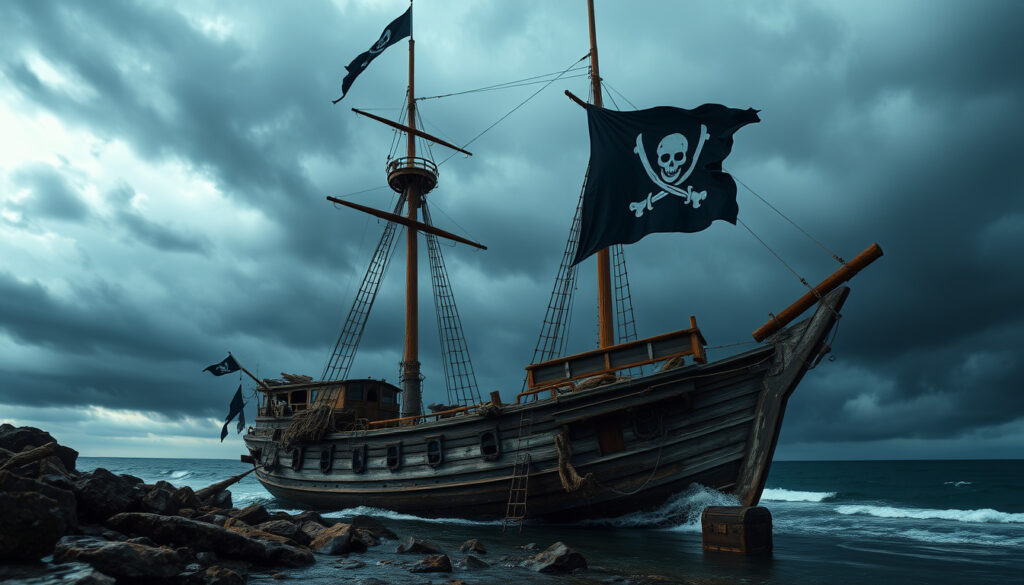
Edward Teach – The Real Pirate Behind Blackbeard Legend
Edward Teach, the man history remembers as Blackbeard, was an English pirate whose brief but spectacular career made him the most famous buccaneer of the Golden Age of Piracy. Active along the Caribbean and the North American Atlantic coast in the early 18th century, he transformed a captured French slave ship into the formidable Queen Anne’s Revenge and built a reputation for theatrical brutality that far outlasted his two years of plundering. His death in a bloody battle off Ocracoke Island on November 22, 1718, cemented his place in history as the archetypal pirate.
Despite his short career, Blackbeard’s name has become synonymous with piracy itself. The National Park Service and Britannica both describe him as one of the most notorious pirates of his era, a figure who understood the power of fear and image long before modern media existed. His story is a mix of verified fact, exaggerated legend, and enduring cultural fascination.
Sources differ on some early-life details, and his exact birthplace and birth year are not known with certainty. What is clear is that Edward Teach, also recorded as Thatch or similar variants, rose from obscurity to become the most recognizable pirate in history.
Who Was Edward Teach? The Real Blackbeard
Edward Teach (also Thatch or Tache)
c. 1680, England (likely Bristol or London)
November 22, 1718, Ocracoke Island, North Carolina
Infamous pirate, captain of Queen Anne’s Revenge, legendary black beard and flag
Blackbeard is one of the most famous pirates due to masterful self-branding and theatrical fright tactics, not because he was the most successful pirate. The following insights help separate the man from the myth.
- Edward Teach is one of the most famous pirates due to masterful self-branding and theatrical fright tactics, not because he was the most successful pirate.
- Despite legends of buried treasure, no evidence exists that Blackbeard ever buried gold — his stolen goods were typically spent or captured soon after.
- The character Blackbeard in One Piece (Marshall D. Teach) is a direct homage to Edward Teach, sharing similar physical bulk, villainous ambition, and cunning.
- Blackbeard’s death battle is one of the most documented pirate confrontations thanks to Lieutenant Robert Maynard’s log entries.
- The wreck of the Queen Anne’s Revenge discovered in 1996 has yielded over 300,000 artifacts, proving the ship’s existence and armament.
| Attribute | Detail |
|---|---|
| Full Name | Edward Teach (variations: Edward Thatch, Edward Tache) |
| Nickname | Blackbeard |
| Birth | c. 1680, England |
| Death | November 22, 1718 (Ocracoke, North Carolina) |
| Height | Historical accounts: tall, muscular (exact height uncertain) |
| Ship | Queen Anne’s Revenge (flagship; 40 guns) |
| Crew Size | Up to 300 pirates at peak |
| Flag | Skeleton with spear and heart (disputed but widely accepted) |
| Spouse | Allegedly married Mary Ormond / 14th wife (legend exaggerated) |
| Cause of Death | Killed by British Navy forces under Lieutenant Maynard |
Where Was Edward Teach Born?
Edward Teach was likely born around 1680, probably in Bristol, England. Some sources suggest London as a possibility, but the exact location remains uncertain. The Royal Museums Greenwich and Britannica both indicate Bristol as the most probable birthplace. He was English by nationality, and his early life before piracy is sparsely documented.
How Tall Was Edward Teach?
Historical accounts describe Blackbeard as a tall, muscular man with a thick black beard that he braided with ribbons. The exact height is not recorded in surviving documents, but contemporary descriptions emphasize his physical size and imposing presence as part of the fearsome image he cultivated.
Who Was Edward Teach’s Wife?
Blackbeard is alleged to have married a woman named Mary Ormond, though the historical record is thin. The legend that he had 14 wives is almost certainly exaggerated. No definitive evidence of marriage exists in official records, and the uncertainty around his personal life is typical of what little is known about pirates outside their criminal activities.
What Ship Did Edward Teach Captain? The Queen Anne’s Revenge
Blackbeard’s most famous ship was the Queen Anne’s Revenge, which he created from a captured French slave ship called La Concorde. After taking the vessel, he renamed it and equipped it as a powerful pirate warship, reportedly carrying about 40 guns and a crew of roughly 300 men. The ship was Blackbeard’s flagship and the main symbol of his brief rise to infamy.
The Queen Anne’s Revenge was originally a French slave ship named La Concorde. After capture, Blackbeard turned it into a warship with 40 cannons and a crew of up to 300 pirates. The wreck was discovered in 1996 near Beaufort, North Carolina, and has yielded over 300,000 artifacts.
The Queen Anne’s Revenge: History and Armament
The vessel began its life as La Concorde, a French ship used in the slave trade. Blackbeard captured it in 1717, renamed it Queen Anne’s Revenge, and refitted it for piracy. With 40 guns and a large crew, it became one of the most heavily armed pirate ships of its time. The ship allowed Blackbeard to dominate shipping lanes and blockade ports, including Charleston, South Carolina.
Blackbeard’s Fleet: How Many Ships Did He Command?
At the height of his power, Blackbeard commanded multiple vessels. The Queen Anne’s Revenge was his flagship, but he also operated with smaller sloops and captured prizes. His fleet allowed him to project power across the Caribbean and the North American coast, though the exact size of his flotilla varied throughout his career.
What Happened to the Queen Anne’s Revenge?
The Queen Anne’s Revenge ran aground in June 1718 at Topsail Inlet, now Beaufort Inlet, North Carolina. Blackbeard intentionally grounded the ship, possibly as a strategy to reduce his crew and consolidate power. The wreck was discovered in 1996, and ongoing conservation efforts have recovered thousands of artifacts, including cannons, medical tools, and personal items. The Queen Anne’s Revenge project continues to document and preserve these finds.
How Did Edward Teach Die? The Battle of Ocracoke
Blackbeard died on November 22, 1718, after a violent battle with forces led by Lieutenant Robert Maynard, acting under orders tied to Virginia authorities. The engagement took place near Ocracoke Island, North Carolina, and remains one of the most documented pirate confrontations in history.
The Final Battle: Lieutenant Maynard vs. Blackbeard
Maynard’s forces engaged Blackbeard’s sloop near Ocracoke Inlet. The battle was fierce and close-quarters. Accounts differ on the exact number and nature of Blackbeard’s wounds, but the National Park Service says he suffered twenty-five stab wounds and five gunshots before dying, while another National Park Service page states he was killed by a wound to the throat. In all versions, he was killed in close combat after a hard fight.
Where Did Blackbeard Die?
The battle took place near Ocracoke Island, off the coast of North Carolina. The exact location is within Ocracoke Inlet, a narrow waterway that became the stage for one of the most famous pirate deaths in history. The site is now part of the Cape Hatteras National Seashore.
What Happened to Blackbeard’s Body After Death?
After the battle, Blackbeard’s head was reportedly displayed on the Ranger’s bowsprit as proof of his death, and his body was thrown overboard. Legend holds that his headless body swam around the ship before sinking, though this is almost certainly myth. His death is often treated as a symbolic end to Atlantic Coast piracy.
Did Blackbeard Really Bury Treasure? Separating Myth from Fact
Blackbeard’s name is often linked to pirate treasure, but the historical record does not support the popular idea of a vast hidden hoard. What is well documented is that authorities sought him partly because of his raids and cargo thefts, and Carolina planters wanted him stopped.
No historical evidence exists that Blackbeard ever buried treasure. The legend of buried pirate gold is a romantic invention of later literature, most notably Robert Louis Stevenson’s Treasure Island, not a documented practice of Edward Teach. His stolen goods were typically spent or captured soon after the raid.
The Famous Myth of Buried Pirate Treasure
The idea that Blackbeard buried treasure has persisted for centuries, but historians agree it is almost certainly fiction. The legend likely grew from the general association of pirates with hidden gold, and from Blackbeard’s outsized reputation. No credible source from his era mentions him burying any loot.
Real Artifacts Found from Blackbeard’s Wreck
While no treasure chest has been found, the wreck of the Queen Anne’s Revenge has yielded over 300,000 artifacts. These include cannons, navigational instruments, medical tools, and personal items. The Smithsonian Magazine has covered the archaeological work extensively, highlighting how these objects provide a tangible connection to Blackbeard’s world.
The artifacts recovered from the Queen Anne’s Revenge wreck site are genuine historical treasures — but they are not buried gold. Cannons, medical tools, and ship fittings tell the real story of a pirate ship’s operations, offering far more historical value than any fictional treasure chest.
Why Is Blackbeard So Infamous Compared to Other Pirates?
Blackbeard’s historical importance comes less from the length of his career than from how effectively he created a terrifying image and captured public attention. Modern histories describe him as one of the most famous pirates ever and a central figure of the Golden Age of Piracy. His blockade of Charleston, South Carolina, was the first major pirate demand on a colonial city, and his tactical surrender to North Carolina Governor Charles Eden may have been a setup for a pardon.
What Were the Key Events in Blackbeard’s Life and Career?
- c. 1680 — Edward Teach born in England.
- 1701–1713 — Serves as a privateer during Queen Anne’s War (War of Spanish Succession).
- 1716 — Joins pirate crew of Captain Benjamin Hornigold.
- 1717 — Captures French slave ship La Concorde, renames her Queen Anne’s Revenge; Hornigold retires.
- 1718 (May) — Blocks Charleston, South Carolina harbor for nearly a week.
- 1718 (June) — Queen Anne’s Revenge runs aground at Topsail Inlet (Beaufort, NC).
- 1718 (Nov 22) — Killed in battle with Lieutenant Robert Maynard.
- 1996 — Queen Anne’s Revenge wreck discovered near Beaufort Inlet, NC.
- 2024–2025 — Ongoing conservation of artifacts from the wreck site.
What Do Historians Know for Certain About Blackbeard?
| Established Information | Information That Remains Unclear |
|---|---|
| Edward Teach existed and was an English pirate active in the Caribbean and North American coast. | His exact birth date and birthplace (likely Bristol or London, c. 1680). |
| He died in combat on November 22, 1718. | Whether he ever legally married (marriage to Mary Ormond is legend, not proven). |
| His flagship was the Queen Anne’s Revenge (former La Concorde). | Exact design of his flag (multiple variations exist in historical drawings). |
| He blocked Charleston, South Carolina for ransom. | Did he really bury treasure? Almost certainly no, but the legend endures. |
| The wreck of the Queen Anne’s Revenge has been found. | His physical appearance beyond written descriptions (no real portrait exists). |
What Did Blackbeard’s Flag Look Like? Symbolism and Fear
Blackbeard’s flag is described by the National Park Service as showing a skeleton holding an hourglass and spear, with a heart dripping blood. That image helped shape his reputation as a terrifying pirate figure. The hourglass symbolized that time was running out for his victims, and the blood-dripping heart emphasized the violence he was prepared to inflict.
His appearance also became part of the legend. The Royal Museums Greenwich notes that he was known for a long black beard and for lighting fuses in it during battle to make himself look demonic. He carried multiple pistols and a cutlass, and famously wore a sling across his chest with pistols in holsters. This theatrical approach to intimidation was a key part of his strategy.
No single flag design is definitively confirmed as Blackbeard’s. Multiple variations exist in historical drawings, and the exact flag he flew may have changed over time. The skeleton-with-spear design is the most widely accepted by historians, but some uncertainty remains.
What Are the Primary Sources on Blackbeard’s Life?
The main sources on Blackbeard’s life come from contemporary accounts, including Lieutenant Maynard’s logs, colonial records, and early pirate histories. The Wikipedia article on Blackbeard provides a comprehensive overview with citations, while the Royal Museums Greenwich offers a trusted museum perspective on his life and legacy.
“Such a day, rum all out. Our company somewhat sober. A damn confusion amongst us! Rogues a-plotting. Great hatred and malice between the captain and his chief mate. Great injustice on the other side. A pox on them all!”
— from Blackbeard’s journal (disputed authenticity)
“Teach was a tall, muscular man with a thick black beard that he braided with ribbons.”
— typical description from early pirate histories
The National Geographic and Britannica both provide well-researched biographical summaries, while the One Piece Wiki documents the fictional character inspired by the real pirate.
What Is the Lasting Legacy of Edward Teach?
Blackbeard’s legacy is one of the most enduring in pirate history. Despite a career that lasted only about two years, he became the archetypal pirate in popular culture. His influence extends into modern fiction, most notably through the character Marshall D. Teach in One Piece, who shares his name and villainous ambition. The ongoing archaeology of the Queen Anne’s Revenge continues to draw media attention, and Blackbeard remains a central figure in the Golden Age of Piracy. For readers interested in other historical figures from the same era, see King Henry VIII – Life, Wives, and Reformation and Martin Luther – Biography, Reformation and 95 Theses.
Frequently Asked Questions About Edward Teach
Was Edward Teach a privateer?
Yes, early in his career he served as a privateer during Queen Anne’s War before turning pirate.
What weapons did Blackbeard use?
He carried multiple pistols and a cutlass; famously wore a sling across his chest with pistols in holsters.
Did Blackbeard have a crew?
Yes, his peak crew size was around 300 pirates across multiple ships, though core crew was smaller.
Where is Blackbeard buried?
No known burial. His head was hung from Maynard’s ship bowsprit, and his body was thrown overboard.
How long was Blackbeard active?
His pirate career lasted only about 2 years (1716–1718), but he became the most famous pirate in history.
What was Blackbeard’s real name?
Edward Teach (also spelled Thatch, Tache). Some sources suggest his real surname was Drummond.
More related posts
 How to Make a GIF – Free Online Tools Guide
 Emma Myers – Age, Height, Movies and Personal Life
 Roman Polanski – Biography, Movies and Legal Case
 Cheyanne King – Registered Nurse and Wife of Actor Gavin Casalegno
 Joan Plowright – Iconic British Actress Dies at 95
 Advent Calendar – Best Beauty, Chocolate & Luxury UK Picks
 Polar Vortex Collapse Weather – Status, Maps and UK Forecast
 Iliman Ndiaye – Height, Ethnicity, Parents, Position & Injury Profile