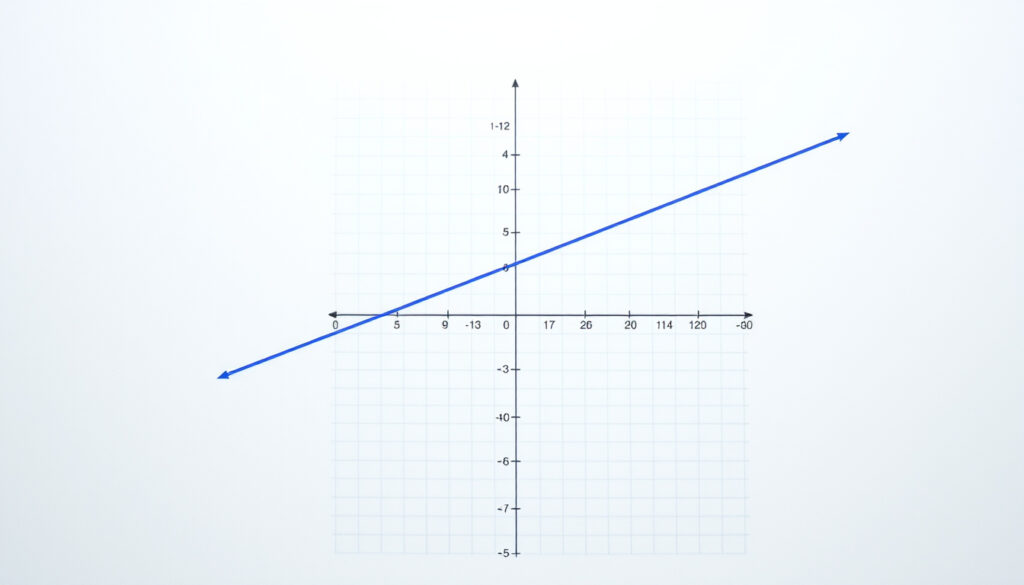
Y=mx+c – Slope, Y-Intercept and Graphing Explained
The equation y = mx + c represents one of the most fundamental concepts in coordinate geometry. Known as the slope-intercept form, it provides a straightforward way to describe any straight line on a Cartesian plane. Understanding this equation opens the door to graphing linear relationships, interpreting data trends, and solving problems across mathematics and science.
Whether you are preparing for GCSE examinations or simply want to refresh your knowledge of basic algebra, y = mx + c serves as the standard starting point. The formula directly reveals two critical pieces of information about a line: its steepness, expressed through the gradient, and its position relative to the y-axis, shown by the y-intercept.
This guide breaks down every component of the equation, demonstrates how to graph it step by step, and clarifies why you might encounter both y = mx + c and y = mx + b in different textbooks.
What Does Each Part of y = mx + c Mean?
The equation y = mx + c contains four variables, each playing a distinct role in defining a straight line. Together, they create a complete description of the line’s orientation and position on the coordinate plane.
Dependent variable (output)
Gradient/slope (steepness)
Independent variable (input)
y-intercept (y when x=0)
What is the gradient (m)?
The letter m represents the gradient, also called the slope. It measures how steep the line is by calculating the ratio of vertical change to horizontal change between two points. Mathematically, this is expressed as m = rise ÷ run, or Δy ÷ Δx. Educational resources from Cuemath and the MathCentre explain that a positive gradient means the line rises as you move from left to right, while a negative gradient indicates the line falls.
When m equals zero, the line is perfectly horizontal. The gradient can also be calculated as m = tan(θ), where θ represents the angle the line makes with the x-axis.
What is the y-intercept (c)?
The letter c denotes the y-intercept, which is the value of y when x equals zero. This tells you exactly where the line crosses the y-axis. The line passes through the point (0, c) on the coordinate plane.
Role of x and y
The variables x and y represent coordinates on the Cartesian plane. When you substitute any value for x into the equation, the result gives you the corresponding y value. This allows you to plot individual points or determine whether a specific coordinate lies on the line.
The slope-intercept form provides the most efficient way to identify both the gradient and y-intercept directly from an equation. A positive gradient creates an upward trend from left to right, while a negative gradient produces a downward trend. The y-intercept determines the line’s starting point on the vertical axis, making it essential for accurate graphing.
| Symbol | Meaning | Example |
|---|---|---|
| m | Gradient | m=2: rises 2 units per 1 x |
| c | y-intercept | c=3: crosses y at 3 |
| x | Input | Any value on x-axis |
| y | Output | Calculated value |
How Do You Graph y = mx + c?
Graphing a line using the slope-intercept form follows a straightforward three-step process. Tutorial resources from Khan Academy show how the method begins with the y-intercept and uses the gradient to find additional points.
First, plot the y-intercept at the point (0, c) on the y-axis. This gives you a starting position for the line. Next, use the gradient m as a ratio of rise to run. For example, if m = 2/1, you move up 2 units and right 1 unit from your starting point. If m is negative, you move in the opposite direction, going down instead of up.
Finally, connect the points you have plotted to draw the complete line, extending it across the coordinate plane.
To graph y = 3x − 5, start at the y-intercept (0, −5). With a gradient of 3, move up 3 units and right 1 unit to reach (1, −2). Continue this pattern to plot more points, then draw a line through them. The result is a steep line that crosses the y-axis below the origin.
For a gentler slope such as y = (1/4)x − 6, the gradient of 1/4 means you move up 1 unit for every 4 units moved to the right. This creates a much shallower line that still crosses the y-axis at −6.
Finding the Gradient from Two Points
If you have two points on a line, you can determine the gradient using the formula m = (y₂ − y₁) ÷ (x₂ − x₁). This calculation works regardless of which point you designate as the first or second, as long as you maintain consistency in subtracting y-values and x-values in the same order.
Derivation of the Equation
The slope-intercept form can be derived from two points on a line. Beginning with the point (0, c) and any other point (x, y), the gradient calculation m = (y − c) ÷ (x − 0) leads to y − c = mx. Rearranging this gives the familiar form y = mx + c.
Is It y = mx + c or y = mx + b?
You may encounter both y = mx + c and y = mx + b when studying linear equations. Educational materials from Third Space Learning note that the choice between c and b depends largely on regional conventions and the specific examination board.
In the United Kingdom and for GCSE examinations, the standard notation uses c to represent the y-intercept. This is the convention followed by major examination boards and widely used educational resources. Some textbooks, particularly those following American conventions, use b instead of c to denote the same value.
Both forms describe identical mathematical relationships. The variable names differ, but their roles remain the same: m continues to represent the gradient in both versions.
When working through problems, always check which notation your course or textbook uses. Mixing conventions can lead to confusion, but the underlying mathematics remains consistent regardless of whether c or b appears in the equation.
| Convention | Equation Form | Region |
|---|---|---|
| UK / GCSE Standard | y = mx + c | United Kingdom |
| Alternative Notation | y = mx + b | United States |
y = mx + c Calculators and Practice Questions
Mastering the slope-intercept form requires practice identifying the gradient and y-intercept from various equation formats. The following practice exercises help reinforce the concepts covered in this guide.
For each equation below, identify the values of m and c:
- y = 5x + 6: m = 5, c = 6
- y = 3x − 11: m = 3, c = −11
- y = −2x + 7: m = −2, c = 7
- y = 9: m = 0, c = 9
- y = 7 − x: m = −1, c = 7
When rearranging equations into slope-intercept form, solve for y to isolate it on one side. For example, converting 5x + 4y = 12 involves isolating 4y to get 4y = −5x + 12, then dividing by 4 to yield y = (−5/4)x + 3.
Converting Between Forms
Equations written in standard form (Ax + By = C) or point-slope form can be converted to slope-intercept form through algebraic rearrangement. Practice with Corbettmaths materials and online graphing tools like interactive graphing calculators helps build confidence in working with different representations of linear relationships.
Digital graphing tools allow you to enter equations in slope-intercept form and immediately visualize how changes to m or c affect the line’s appearance. Adjusting the gradient demonstrates the relationship between slope and angle, while modifying the y-intercept shows how the line shifts vertically.
Analyzing and Using y = mx + c
The slope-intercept form extends beyond theoretical mathematics into practical applications across science, economics, and engineering. Understanding how to extract meaningful information from linear equations prepares students for real-world problem solving.
In physics, linear relationships describe constant velocity motion, where distance travelled equals velocity multiplied by time, plus an initial position. In business, cost functions often follow this pattern, with a fixed cost component and a variable rate per unit produced.
The ability to quickly identify whether a relationship is linear, and to describe it precisely using y = mx + c, provides a foundation for more advanced mathematical topics including calculus, statistics, and data analysis.
Expert Sources and References
The explanation of y = mx + c draws on established educational resources recognised for their authority and accuracy in mathematics instruction.
BBC Bitesize describes the equation as “y = mx + c where m is gradient” and emphasises its role in understanding straight line graphs for GCSE mathematics.
Third Space Learning defines it as “the general equation of a straight line” and provides comprehensive tutorials on identifying and using each component.
MathCentre, a university-level resource, explains that c represents “the y-axis cut value” and offers detailed derivations from first principles.
Additional authoritative sources include Khan Academy, which provides video tutorials on graphing techniques, and Cuemath, which offers interactive explanations of the mathematical principles underlying the formula.
What’s Next: Advanced Topics
Once you have mastered the slope-intercept form, several related topics build on this foundation. Understanding perpendicular and parallel lines involves comparing gradients, while exploring the relationships between different forms of linear equations deepens your algebraic fluency.
For those continuing their mathematical journey, learning about slope calculation methods and conversion formula techniques provides practical applications of gradient concepts in everyday contexts.
Frequently Asked Questions
What does m represent in y = mx + c?
The letter m represents the gradient or slope of the line, measuring how steep the line rises or falls as x increases.
What does c represent in y = mx + c?
The letter c represents the y-intercept, which is the value of y when x equals zero. This is where the line crosses the y-axis.
How do you find the gradient from two points?
Subtract the y-values and divide by the difference in x-values: m = (y₂ − y₁) ÷ (x₂ − x₁).
Why do some textbooks use y = mx + b instead?
Different regional conventions exist. UK and GCSE resources typically use c, while American textbooks often use b for the y-intercept.
Can y = mx + c represent a horizontal line?
Yes, when m equals zero, the equation simplifies to y = c, which represents a horizontal line passing through the point (0, c).
How do you convert an equation to y = mx + c form?
Isolate y on one side of the equation through algebraic manipulation, ensuring the coefficient of x is on the right side of the equals sign.
More related posts
 Bhad Bhabie – Biography, Net Worth and 2026 Update
 Holliday Grainger – Biography, Movies, TV Shows, Career
 Tory Lanez – Prison Sentence, Appeals and 2026 Update
 Cassie Ventura – Key Witness in the Diddy Trial
 Jeff Bridges – Biography Movies Net Worth and Health
 David Bowie – Biography, Cause of Death, and Enduring Legacy