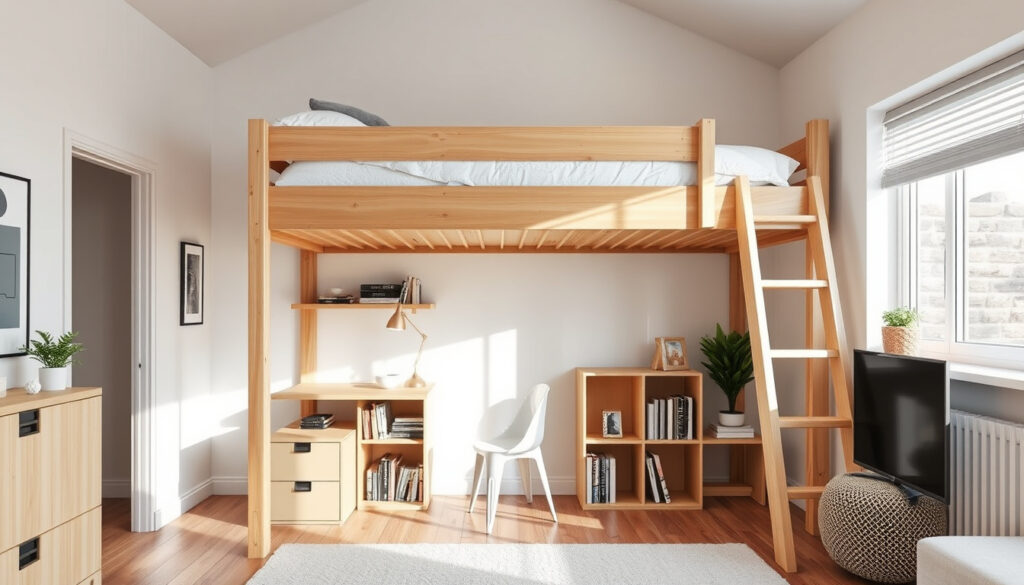
Loft Bed – Complete Buying Guide for Adults in the UK
Loft beds are no longer just a childhood rite of passage. Across the UK, adults are turning to raised sleeping platforms to free up floor space in small flats, studio apartments, and shared houses. By lifting the mattress off the ground, a loft bed opens the area below for a desk, wardrobe, shelves, or even a compact sofa.
Choosing the right model takes more than measuring the room. Buyers need to consider weight limits, ceiling clearance, mattress depth, and the safety standard that applies to elevated beds in the UK: BS EN 747-1:2019. Buying guides stress that adult use demands a frame built for adult loads, not a children’s bed with a higher price tag.
The market now spans budget-friendly options at IKEA and Argos, design-led specialist ranges, and heavy-duty frames built for daily adult use. The right choice depends on how the bed will be used, who will sleep in it, and what needs to fit underneath.
What Are the Best Loft Beds for Adults?
Adult loft beds vary widely in price, materials, and load rating. The four areas below cover what matters most.
- Adult Loft Beds: Space-saving sleep solutions for adults – weight capacities, comfort, and design options.
- Top UK Brands: IKEA, Argos, Millie & Jones, Room to Grow and others – key models and prices.
- Must-Have Features: Desks, wardrobes, double sizes, and safety rails – what to look for.
- Buying Guide Basics: Sizes, mattress types, assembly, and budget – everything you need to know.
The practical case for a loft bed is simple: it turns unused vertical space into a sleeping area and leaves the floor free. In small UK bedrooms, that usually means a desk, wardrobe, shelves, or sofa underneath.
- Loft beds are popular among adults in small apartments or studios for maximising floor space.
- IKEA offers the widest range of affordable loft beds with desks and storage.
- Weight limits vary by model; most adult-friendly loft beds support up to 200–250 kg.
- Double loft beds (140×200 cm) are rare but available from specialist UK retailers.
- Safety standards (BS EN 747) are crucial for adult loft beds, especially for upper-bunk guardrails.
- A common recommendation is at least 75–90 cm of clearance above the mattress so you can sit up comfortably.
| Fact | Detail |
|---|---|
| Typical price range | £150 – £1,200 |
| Common mattress sizes | Single (90×190 cm), Double (140×200 cm) |
| Average weight capacity | 150–250 kg for adult models |
| Assembly time | 1–4 hours depending on complexity |
| UK safety standard | BS EN 747-1:2019 |
| Recommended ceiling height | Around 2.4 m |
| Recommended mattress depth | Around 15–20 cm |
| Under-bed use | Desk, wardrobe, shelves, or sofa |
Adult loft beds are generally built with higher load capacities than children’s models. UK buying guides place adult-use capacities around 200–300 kg, while broader market lists range from roughly 250 to 700 lb depending on construction. That wide spread is a reminder to check the exact rating of any frame you are considering. One source covering whether adults can sleep in bunk beds highlights the same point about verifying the stated load. For the wider market, Forbes’ best loft bed list and House Beautiful’s adult loft bed round-up show how much the category has expanded.
European safety standard BS EN 747-1:2019 is the benchmark for bunk beds and high beds in the UK. Guidance highlights guard rails, ladder stability, anchoring, mattress thickness, and weight capacity as the main safety checks. Ceiling height matters as much as the frame: UK sources recommend at least 75–90 cm of clearance above the mattress, and one guide frames 2.4 m as an ideal ceiling height. For a closer look at adult-specific models and UK market options, the Loft Beds UK Buying Guide is a useful starting point.
Which Loft Bed Brands Are Available in the UK?
For most UK buyers, the choice starts with IKEA and Argos. Both offer loft beds at accessible prices, but the practical differences usually come down to price, style, storage options, and stated load rating. The exact model specs matter more than the retailer name.
Which loft bed does IKEA offer?
IKEA’s loft-bed category is weighted toward children and teens, but several frames can work for adults once you confirm the load rating. The range is strong on space-saving design, modular storage ideas, and product-family consistency. Some IKEA bed frames carry long warranties, with one UK buying guide noting 10 years on some frames.
IKEA’s own safety note states that high beds are unsuitable for children under 6. Adult suitability still depends on the specific frame and its load rating, so the product page needs a close read. IKEA UK’s loft bed category shows the current range and specifications.
What does Argos offer?
Argos has a wide selection and frequent budget-to-midrange options. UK shopping pages show Argos-branded loft-style beds in the market. Product pages can vary a lot, so verify materials, mattress size, weight limit, and assembly requirements rather than assuming adult suitability. The Argos loft bed range is worth browsing with those checks in mind.
What about Millie & Jones, Room to Grow and other UK retailers?
Beyond the big two, specialist retailers add design-led choices. Millie & Jones sells stylish high sleeper beds with a youth-oriented, space-saving focus. Room to Grow offers a loft bed category aimed at quick browsing, and its loft bed selection is typical of the commercial product-grid approach. Noa & Nani takes a modern, design-led direction, while Little Folks Furniture focuses on premium children’s loft beds. None of these specialist pages offers a comprehensive adult buying guide, so the same spec-checking rule applies.
| Retailer | Likely strengths | Watch-outs |
|---|---|---|
| IKEA UK | Often strong on space-saving design, modular storage ideas, and clearer product-family consistency; some IKEA bed frames carry long warranties, with one UK buying guide noting 10 years on some frames. | Check whether the model is intended for children or teens only or suitable for adults; IKEA’s own loft-bed category includes the safety note that high beds are unsuitable for children under 6, but adult suitability still depends on the specific frame and load rating. |
| Argos | Wide selection and frequent budget-to-midrange options; UK shopping pages show Argos-branded loft-style beds in the market. | Product pages can vary a lot, so verify materials, mattress size, weight limit, and assembly requirements rather than assuming adult suitability. |
Retailer reputation is less important than the individual product sheet. UK guidance consistently says to verify the weight limit, mattress size, materials, and assembly requirements for the exact model you plan to buy. The same retailer can sell frames aimed at children and frames rated for adults.
What Are the Key Features to Look for in a Loft Bed?
Once the room is measured, the next step is matching the frame to how it will be used. The main variables are size, storage, desk space, and mattress constraints.
What is a double loft bed?
“Double” usually means a larger sleeping surface, but the exact dimensions need checking. Some models marketed as doubles are smaller UK sizes wearing the label loosely. A true double loft bed gives a 140×200 cm mattress area, which is rare but available from specialist UK retailers.
Adult double loft beds should have a clearly stated maximum load. A conservative adult benchmark in one UK bunk-bed guide is 120–150 kg per sleeping level, while sturdier adult models may go higher. For longevity and load performance, solid wood or steel beats particleboard or MDF. PriceSpy’s loft bed listings show how widely dimensions and prices vary across the market.
What loft bed wardrobe options are available?
Wardrobes are one of the most requested additions beneath a loft bed. Some frames arrive with integrated wardrobes or shelving; others leave the space open so you can add your own storage. In small UK bedrooms, the combination of a raised bed and a wardrobe underneath can replace both a bed and a separate clothes storage unit. Wayfair’s loft bed buying guide makes the same space-saving point.
What are the best loft beds with desks?
Desks are the other staple under-bed feature. Loft beds with desks are common in IKEA’s range and among specialist high sleeper models. The desk needs enough depth for a monitor or laptop, and the underside of the bed becomes the ceiling of the work area, so check the clearance carefully before buying.
What size mattress does a loft bed need?
Most single loft beds use a standard UK single mattress at 90×190 cm. Double loft beds use 140×200 cm. Beyond length and width, depth matters more than most buyers expect. Several UK sources recommend a lower-profile mattress, often around 15–20 cm, so the sleeper stays safely below the guard rails. Cosy Bunks’ high sleeper collection makes the same point about mattress depth. The Ultimate Guide to Loft Beds also covers frame stability and mattress limits in detail.
For everyday adult use, stairs are usually easier and safer than a steep ladder. Angled ladders are better than vertical ones, and a non-slip surface on the steps reduces the risk of slips in the dark.
How to Choose the Right Size and Configuration for Your Room?
Configuration starts with measurements. Before ordering, measure floor space, ceiling height, doorways, stairs, and hallways. A bed that fits the bedroom on paper can still fail to get through the front door or sit safely under a sloped ceiling.
How much space do you need?
A standard single loft bed uses a 90×190 cm mattress and is the smallest practical size for an adult. Double loft beds require more floor footprint but leave a larger sleeping surface. UK guides frame 2.4 m as an ideal ceiling height, with at least 75–90 cm of clearance above the mattress. Famaya Luxury Beds’ guide to adult high sleeper beds sets out these ceiling recommendations for UK homes.
Can you put a loft bed against a wall?
Yes, most loft beds are designed to be placed against a wall. The ladder or stairs need to stay accessible, and the frame should be stable once assembled. Some designs require anchoring to the wall, especially where the instructions specify it. EZ Space’s loft bed guide confirms that the frame should be securely fixed where the design requires it.
Safety checklist before buying
The following points appear repeatedly in UK guidance:
- Measure floor space, ceiling height, doorways, stairs, and hallways before ordering.
- Confirm the maximum user weight plus mattress and bedding is below the frame limit.
- Prefer a frame with full-length guard rails and a secure, non-slip ladder or stairs.
- Use a mattress that fits the manufacturer’s depth limit.
- Avoid DIY modifications that could weaken the structure.
- If the bed is for everyday adult use, prioritise steel or solid hardwood and strong joinery over decorative design features.
Strictly Beds and Bunks’ heavy-duty buying guide covers guard rails, ladder stability, and anchoring in more detail.
DIY modifications can weaken the structure of a loft bed. UK guidance advises against cutting, drilling, or reinforcing frames without the manufacturer’s approval, because the original engineering and safety certifications no longer apply once the frame is altered.
How Have Loft Beds Evolved Over the Years?
- Children’s rooms first: Loft beds and high sleepers were long associated with children’s bedrooms, with most models sized and rated for younger users.
- 2000s – small-space living: The rise of micro-apartments and urban studio living made raised beds useful for adults who needed extra floor area.
- 2010s – adult trend: The adult loft bed gained momentum as retailers introduced higher weight ratings, sturdier materials, and designs suited to living spaces.
- 2025 – integrated systems: Current models increasingly combine the bed with a desk, wardrobe, shelving, and smart features such as built-in lighting and USB ports.
- Looking ahead: Co-living spaces and modular, customisable loft systems are expected to keep driving demand for adult-friendly models.
The shift toward adult models is visible in UK buying guides, which now discuss adult weight ratings and BS EN 747-1:2019 compliance as standard considerations rather than exceptions.
How Much Weight Can a Loft Bed Safely Hold?
Weight capacity is the single most important spec for an adult buyer, and it is also the spec most likely to be missing from a product page.
| Established | Still unclear |
|---|---|
| Adult loft beds are generally built with higher load capacities than children’s models. | Weight limits are not always published by all retailers; check the product spec sheet. |
| UK buying guides place adult-use capacities around 200–300 kg. | Exact capacity differs by construction, so the range is only a starting point. |
| A conservative adult benchmark for double loft beds is 120–150 kg per sleeping level. | Comfort and durability depend on mattress quality, not just the frame rating. |
| Safety standards such as BS EN 747-1:2019 exist for raised sleeping areas. | Assembly difficulty varies widely by model, and a poorly assembled frame can reduce its real-world capacity. |
BS EN 747-1:2019 specifies guardrail heights and gap sizes for bunk beds and high beds, and it is the standard UK guidance refers to when assessing adult loft beds. The Which? bunk bed safety guide also advises checking the weight limit before buying a loft bed for an adult. More detail on the standard itself is available from BSI Group.
Loft Bed vs Bunk Bed: What Is the Difference?
The difference is structural. A bunk bed has two stacked sleeping surfaces, meaning the lower bed sits close to the floor and the upper bed is reached by a ladder. A loft bed has one elevated sleeping area with open space underneath, which can be used for a desk, wardrobe, shelves, or seating.
For small rooms, that open space is the deciding factor. A loft bed gives back floor area that a second bed would occupy, which is why it is often the better choice for a single occupant who wants a workspace or storage zone. A bunk bed makes more sense when two people need to sleep in the same room.
The trade-off is access. Raising the bed adds a climb, and safety depends on guard rails, ladder stability, and correct mattress depth. UK guidance treats loft beds and bunk beds under the same safety umbrella: BS EN 747-1:2019 covers both.
What Do Retailers and Safety Standards Say?
Our loft beds are built with safety and fun in mind – sturdy frames, secure ladders, and high rails.
IKEA UK, loft bed product pages
European standard for bunk beds and high beds; specifies guardrail heights and gap sizes.
BS EN 747
Always check the weight limit before buying a loft bed for an adult.
Which? UK, consumer advice
These three sources reflect the broader picture: retailers emphasise safety features in their marketing, the standard sets the technical requirements, and consumer advice organisations focus on the practical checks that buyers often overlook.
What Should Buyers Prioritise in 2025?
For most adult buyers in the UK, the right loft bed combines a clear adult weight rating, BS EN 747-1:2019 compliance, stairs or a stable ladder, enough room underneath for a desk or wardrobe, and a mattress depth that keeps the sleeper safely below the rails. Models that hit all five points tend to cost more, but they also tend to last longer and feel more stable in daily use.
What Do UK Buyers Ask About Loft Beds?
Are loft beds safe for adults?
Yes, when the frame is designed for adult use, assembled correctly, and used within its stated weight limit. Look for full-length guard rails, a secure ladder or stairs, and BS EN 747-1:2019 compliance. Mattress depth should keep the sleeper safely below the rails.
Are loft beds comfortable for sleeping?
Comfort depends mainly on the mattress. A loft bed can feel like a regular bed if you choose a quality mattress in the correct size and depth. The frame itself affects comfort less than the mattress and bedding.
How to assemble a loft bed?
Follow the manufacturer’s instructions. Most frames require two people, a drill, and basic tools. Some retailers offer assembly services. Fix the frame to the wall when the design requires anchoring, and avoid modifying the structure.
What is the cheapest loft bed in the UK?
IKEA’s TARVA loft bed starts around £150. Argos also offers budget models under £200. Cheaper frames are often made of particleboard, so check the weight limit and materials carefully before buying.
What is the best loft bed for a small adult bedroom?
A single-size loft bed with a desk or wardrobe underneath is usually the best fit. Check ceiling height, weight limit, and BS EN 747-1:2019 compliance before ordering.
Where to buy loft beds in the UK?
IKEA and Argos offer the widest choice at budget-to-midrange prices. Specialist retailers such as Millie & Jones, Room to Grow, and Noa & Nani offer design-led options. Compare exact specs before ordering.
More related posts
 Mark Labbett – Biography, Career, and Personal Life Updates
 Doki Doki Literature Club – Free Download and Android Guide
 How to Find National Insurance Number – Free HMRC Online Guide
 How to Cook Chicken Breast – 4 Methods for Perfect Juicy Results
 Guy Burnet – British Actor from Hollyoaks to Oppenheimer
 Chris Martin Coldplay – Age, Net Worth, and Personal Life
 Micah Richards – Biography, Career Stats, Punditry Journey
 Sian Gibson – Biography, Career, Height, and Net Worth