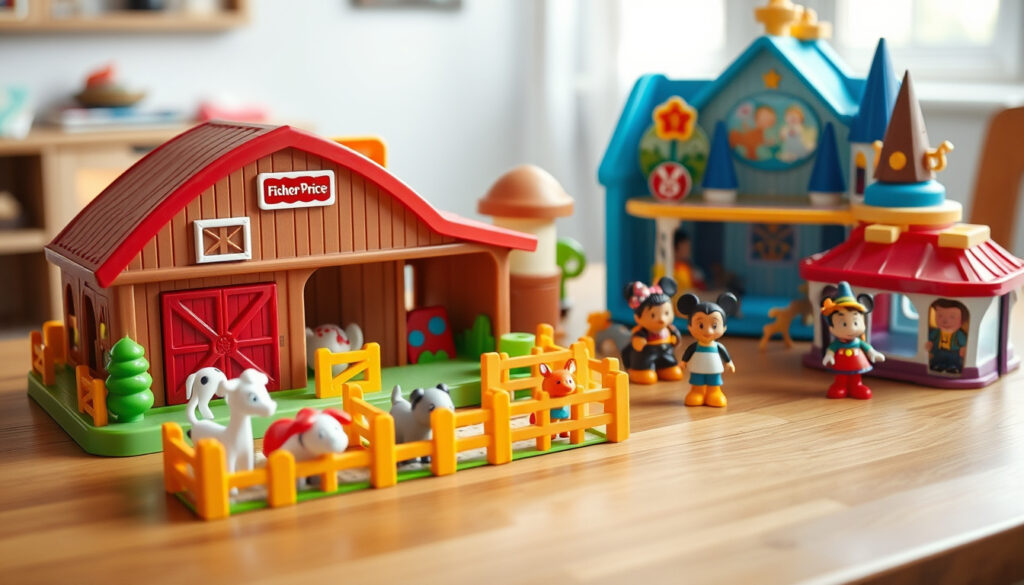
Fisher-Price Little People – Figures Farm Disney Playsets Guide
Fisher-Price Little People has been a cornerstone of imaginative play for toddlers since the early 1950s, evolving from simple wooden figures into the chunky, detailed plastic figures recognised worldwide today. The line encompasses a diverse range of playsets, from classic farm themes to various licensed partnerships, appealing to young children aged 6 months through 3 years and beyond. Understanding the range, history, and safety considerations of these toys helps parents make informed purchasing decisions for their little ones.
The brand has undergone several significant redesigns over its seven-decade history, each bringing new features and safety improvements. From the original wooden peg figures to today’s detailed characters with articulated features, Little People has maintained its position as a trusted name in early childhood toys. Parent company Mattel, which acquired Fisher-Price in 1991, continues to expand the line with new themes and play experiences.
This guide examines the complete Fisher-Price Little People range, exploring figures, playsets, themed collections, and essential buying considerations for parents and gift-givers seeking quality toys for toddlers.
Fisher-Price Little People Figures
The defining feature of the Little People line has always been its figures—small, recognisable characters designed for small hands to grasp, manipulate, and use in imaginative play scenarios. These figures form the foundation of every playset and collection within the brand.
Chunky figures crafted for toddlers ages 6-36 months, with rounded edges and durable plastic construction
Farm, House, Garage, Airport, School, and various licensed collections spanning decades of play
Designed primarily for children 1-5 years, with specific sets rated for 6 months plus
Fisher-Price, a subsidiary of Mattel since the 1991 merger, producing toys in the United States and abroad
Key Benefits of Little People Figures
- Encourage imaginative role-play and storytelling through open-ended scenarios
- Chunky design promotes fine motor skill development in toddlers
- Durable construction withstands years of regular play
- Consistent character proportions work across all playsets and collections
- Named characters like Eddie, Tessa, Mia, Koby, and Sofie provide relatable personalities
- Licensed themes (Sesame Street, various collaborations) offer familiar characters for children
- Educational elements integrated into modern sets, including alphabet and animal recognition
| Fact | Details |
|---|---|
| Brand | Fisher-Price Little People |
| Target Age | 6 months to 3+ years (varies by set) |
| Trademark Established | 1985 (previously “Play Family”) |
| Parent Company | Mattel (acquired 1991) |
| Key Products | Figures, Farm, House, Garage, Airport playsets |
| Current Characters | Eddie, Tessa, Mia, Koby, Sofie |
| Production Material | Plastic exclusively since late 1960s |
| Collector Value | Pre-1990 classic sets highest valued |
| Safety Redesign | 1991 “Chunky” version (wider, shorter) |
| Modern Update | 1997 redesign with arms and detailed features |
| Price Range | Approximately $10-60 per set |
| First Playset | 1968 Play Family Barn |
Pre-1991 figures posed choking hazards for young children due to their size and shape. The 1991 Chunky redesign addressed these concerns by creating wider, shorter figures that are safer for the intended 6-36 month age group. Parents should avoid purchasing vintage pre-1991 sets for toddlers.
Fisher-Price Little People Farm
The Farm theme represents one of the longest-running and most beloved collections in the Little People lineup. Originating with the 1968 Play Family Barn, farm playsets have remained a staple of the brand across multiple generations of children.
The Original Play Family Barn
The Play Family Barn debuted in 1968 as the first official Little People playset, retailing at $9.99 (equivalent to approximately $60 today). This pioneering set introduced several features that would become hallmarks of the line, including the iconic “moo” sound door that delighted children and encouraged interaction. The original barn featured plastic construction that marked the transition away from earlier wooden components.
Farm Playsets Through the Decades
Throughout the 1970s and 1980s, farm sets expanded to include additional buildings, animals, and figures. The original concept of a functional playset with removable pieces and storage capability evolved into the “Play and Carry” design philosophy, where sets could store figures and accessories inside, making cleanup easier and transport more convenient for families.
Modern farm playsets continue to feature the agricultural theme while incorporating contemporary design elements. These sets typically include multiple buildings, animal figures, vehicles, and accessories that encourage extended imaginative play sessions. The durability of modern sets ensures they can handle the rigours of regular play while maintaining their appearance and functionality.
Classic farm playsets have appeared in nearly every decade since 1968, with the Play Family Barn being re-released multiple times with various updates and improvements. Each iteration has maintained the core agricultural theme while incorporating contemporary safety standards and educational elements appropriate for the target age group.
Fisher-Price Little People Disney
Disney-themed Little People sets represent one of several licensed partnerships that have expanded the brand’s reach over the decades. While not as extensively documented as the Sesame Street collaboration, Disney sets demonstrate Fisher-Price’s strategy of incorporating beloved characters into the Little People format.
Licensed Partnerships History
The history of Little People licensing reveals a selective approach to partnerships. The first major licensed collaboration came in the mid-1970s with the Sesame Street town playsets, featuring characters like Bert and Ernie. A brief McDonald’s partnership in 1990 introduced Ronald McDonald into the line, though this collection was short-lived.
Disney collaborations have appeared periodically in the Little People range, though the core focus of the brand has remained on generic family and community themes rather than heavily branded content. Parents seeking Disney-themed Little People sets should check current availability directly through Mattel’s official channels, as licensed product lines frequently rotate based on commercial agreements.
Current Disney Availability
Specific Disney Princess, Toy Story, and Frozen Little People sets lack direct documentation in current retail data. The core Little People collection continues to emphasise universal themes that appeal broadly, with licensed sets representing a smaller portion of the overall lineup. Families interested in Disney-themed versions are encouraged to verify current product availability through Mattel’s shopping platforms.
Licensed Little People sets, including those featuring Disney properties, experience variable availability based on ongoing commercial agreements between Mattel and various entertainment companies. Product lines rotate regularly, and specific sets may be discontinued or replaced without notice. Checking directly with official Mattel retailers ensures the most current information on themed set availability.
Fisher-Price Little People Princess
Princess-themed toys represent a significant category within many toy manufacturers’ portfolios, and Fisher-Price has explored this theme within the Little People line. However, the Little People collection maintains a broader focus on family-friendly, universally appealing scenarios rather than concentrating on any single theme.
Generic vs. Themed Sets
The Little People philosophy has historically emphasised generic, family-oriented playsets that allow children to create their own narratives without rigid storylines tied to specific entertainment properties. This approach provides greater flexibility for imaginative play but means that heavily themed collections like princess-specific sets may receive less developmental attention compared to other manufacturers’ dedicated princess lines.
Finding Princess-Themed Options
Parents specifically seeking princess-themed Little People sets should consult current Mattel and Fisher-Price product catalogues. While specific Disney Princess Little People documentation remains limited in available research, the company’s licensing agreements with Disney suggest that such products may be available periodically through official retail channels.
Fisher-Price Little People Toy Story
Toy Story represents one of Disney/Pixar’s most successful franchises, and Fisher-Price has explored Little People versions featuring these characters. The playful nature of the Toy Story films—featuring toys coming to life—aligns conceptually with the Little People approach of encouraging children to animate their figures through imagination.
Cross-Brand Strategy
Fisher-Price’s approach to franchise collaborations involves carefully balancing brand recognition against the universal appeal that has made Little People successful. Toy Story sets within the Little People line would adapt the franchise’s characters to the chunky, safe format appropriate for toddlers, potentially including playsets based on familiar locations from the films.
Age Appropriateness Considerations
The Toy Story franchise, while beloved by families, primarily targets children older than the Little People core demographic. Parents should consider whether a toddler-appropriate Toy Story Little People set exists before purchasing, as franchise films often contain content more suitable for preschool-aged children and up rather than the 6-month to 3-year audience that Little People primarily serves.
Fisher-Price Little People Frozen
Disney’s Frozen franchise has generated substantial licensed merchandise across numerous toy categories. Fisher-Price’s potential Little People Frozen sets would adapt the winter wonderland aesthetic and beloved characters like Anna and Elsa into the distinctive Little People format.
Frozen Theme Adaptability
The Frozen franchise’s emphasis on family relationships and magical winter themes could translate well to Little People playsets, though specific documented sets featuring Frozen characters remain limited in available research data. The general absence of detailed Frozen-specific documentation suggests either limited releases, product discontinuation, or releases not captured in the current literature review.
Current Product Verification
Families hoping to find Little People Frozen sets are advised to check directly with Mattel’s official retail partners. The rotating nature of licensed product agreements means that discontinued sets may be replaced by new collaborations, and current availability can only be confirmed through real-time retail databases rather than historical documentation.
When searching for specific themed Little People sets like Frozen or Toy Story, using search terms combining “Fisher-Price Little People” with the franchise name on official Mattel retail platforms provides the most accurate current availability information. Third-party retailers may carry older stock or have outdated product databases.
Timeline: Evolution of Fisher-Price Little People
The Fisher-Price Little People line has undergone significant transformations since its inception, evolving through distinct phases that reflect changing manufacturing capabilities, safety regulations, and design philosophies. Understanding this evolution helps parents contextualise the products available today and make informed decisions about vintage versus modern purchases.
- 1950-1959: Early precursors emerge with attached round-headed figures in pull-along vehicles including the “Looky Fire Truck” (1950), “Super-Jet” (1952-1953), and “Safety School Bus” (1959) featuring cardboard figures.
- 1960: First removable plastic figures appear in the “Snorky Fire Engine” and “Nifty Station Wagon,” establishing the “Play Family” concept.
- 1965: Iconic peg-style figures with waist taper introduced, becoming the recognisable format that persisted for decades.
- 1968: Play Family Barn launches as the first official playset, introducing sound features and plastic construction that replaced wood.
- 1969: Play Family Dollhouse expands the playset line with multi-room interactive design.
- 1970-1972: Playset line broadens significantly with Action Garage (1970), School (1971), and Airport (1972).
- Mid-1970s: First major licensed collaboration produces Sesame Street town sets featuring Bert and Ernie.
- 1974-1998: Jumbo Little People (larger “Big People”) produced as an alternative size range.
- 1982: Western Town and Fire Station sets added to the classic collection lineup.
- 1985: “Little People” trademark officially formalised, replacing “Play Family” as the product line name.
- 1990: Brief McDonald’s licensed set introduces Ronald McDonald into the collection.
- 1991: “Chunky” redesign prioritises safety with wider, shorter figures following documented choking concerns.
- 1997: Modern redesign introduces articulated arms, detailed faces, and named characters reviving brand interest.
- 2004: A to Z Learning Zoo expands the line with educational elements featuring 26 animals and alphabet recognition.
What Is Confirmed and What Remains Unclear
Transparency about what is definitively known versus what requires further verification helps readers understand the reliability of information presented about Fisher-Price Little People products. Several aspects of the brand have clear documentation while others remain subject to ongoing research.
| Established Information | Information Requiring Further Verification |
|---|---|
| Fisher-Price Little People trademark established in 1985 | Specific availability of current Disney Princess sets |
| First playset was the 1968 Play Family Barn | Whether Toy Story Little People sets currently exist |
| Mattel acquired Fisher-Price in 1991 | Current Frozen-themed set availability |
| 1991 Chunky redesign addressed documented safety concerns | Specific McDonald’s set production quantities and current collector value |
| Classic pre-1990 sets command highest collector premiums | Exact pricing structures across modern retailers |
| Sesame Street collaboration began mid-1970s | Whether Disney Princess Little People sets were ever produced in significant numbers |
Understanding the Fisher-Price Little People Range
The Fisher-Price Little People collection occupies a distinct niche within the broader toy market, focusing specifically on toddlers and young children rather than attempting to serve all age groups. This focused approach shapes everything from figure design to playset complexity.
The brand’s strength lies in its understanding of developmental needs for children in the 6-month to 3-year age range. Chunky figures are designed specifically for small hands still developing fine motor coordination, while durable construction withstands the inevitable dropping, banging, and general play that characterises this age group. The consistent scale across all figures and playsets means that children can combine elements from different sets, creating unlimited imaginative scenarios.
Educational integration has become increasingly sophisticated since the 2004 A to Z Learning Zoo introduced explicit learning objectives. Modern sets incorporate interactive elements that encourage sound recognition, animal identification, and early vocabulary development, though the core appeal remains the open-ended imaginative play that has characterised the line since its inception.
Sources and Official Statements
Multiple authoritative sources document the Fisher-Price Little People history and product evolution. Wikipedia’s comprehensive entry on Little People toys provides detailed timeline information and product documentation. The Fisher-Price Fan Wiki offers extensive community-curated information about individual sets and historical context.
“New characters to meet and imaginations to inspire” — Fisher-Price official brand messaging describing the Little People line’s contemporary purpose and developmental goals.
Mental Floss contributed accessible historical overview articles documenting the brand’s evolution from wooden precursors through major redesigns. Collector resources including The Fisher-Price Club and This Old Toy provide detailed information about vintage productions and collector market values.
For current product information, Mattel’s official platforms serve as the primary authoritative source, including the Fisher-Price website and Mattel’s Little People collection page. These resources provide real-time availability information and current pricing that cannot be replicated through secondary research sources.
Summary and Recommendations
Fisher-Price Little People has maintained its position as a trusted name in toddler toys for over seven decades, evolving from simple wooden figures to the detailed, chunky plastic characters recognised globally today. The line excels at providing safe, durable, imaginative play experiences specifically designed for children ages 6 months to 3 years and beyond.
For parents and gift-givers, the key recommendations are straightforward: prioritise age-appropriate safety by avoiding vintage pre-1991 sets for young children, focus on the core playsets (Farm, House, Garage) for maximum play value, and verify current availability of themed sets directly through Mattel’s official channels. The Silver Cross High Chair Review provides related guidance on selecting safe, quality products for young children in this age range.
Whether selecting a classic Farm playset for nostalgic parents or exploring the full range of modern Little People options, the brand’s commitment to safe, educational, imaginative play remains evident across its contemporary offerings.
Frequently Asked Questions
What age is appropriate for Fisher-Price Little People toys?
Little People toys are primarily designed for children aged 6 months to 3 years, with specific sets carrying ratings from 6-36 months. Some sets extend to children aged 3-5 years depending on complexity and choking hazard considerations.
Are Fisher-Price Little People sets safe for toddlers?
Modern Little People sets (1997 onward) are designed with toddler safety as a priority, featuring chunky figures that meet current safety standards. Pre-1991 vintage sets may pose choking hazards and are not recommended for children under 3 years.
How much do Little People playsets cost?
Modern Little People playsets typically range from approximately $10 to $60 depending on complexity, number of pieces, and special features. Classic vintage sets in good condition may command significantly higher prices in collector markets.
Where can I buy authentic Fisher-Price Little People products?
Authentic products are available through Mattel’s official platforms including Fisher-Price.com and Mattel.com, as well as major retailers like Amazon, Argos, and Smyths Toys. Purchasing from authorised sellers ensures product authenticity and warranty coverage.
Do Fisher-Price Little People sets work together?
Yes, figures and playsets within the Little People line are designed to be compatible. Consistent scale and proportional design allow figures from any set to be used with any playset, supporting open-ended imaginative play.
What is the most valuable Little People collectible?
Pre-1990 classic sets, particularly the original 1968 Play Family Barn and early wooden/plastic combinations, command the highest collector premiums. Condition, completeness, and original packaging significantly affect collector value.
Are there Disney Princess Little People sets currently available?
Specific current availability of Disney Princess Little People sets cannot be confirmed through available research documentation. Licensed product lines experience variable availability based on commercial agreements. Direct verification through Mattel retail platforms is recommended.
What was the first Little People playset?
The 1968 Play Family Barn was the first official Little People playset, featuring the iconic “moo” sound door and representing the brand’s transition from separate figures and vehicles to integrated playset experiences.
Has Fisher-Price Little People been discontinued?
Fisher-Price Little People has not been discontinued. The line remains active under Mattel’s ownership, with new sets released periodically and core classic sets remaining in production. The brand continues to evolve with contemporary design and educational elements.
What educational benefits do Little People toys provide?
Little People playsets encourage imaginative play, fine motor skill development through grasping and manipulating figures, language development through storytelling scenarios, and learning through integrated educational elements in specific sets like the A to Z Learning Zoo.
More related posts
 Emma Myers – Age, Height, Movies and Personal Life
 Anya Chalotra – Complete Guide to Her Career and Biography
 Map of North America – Countries, Terrain, Blank Maps Guide
 Bar Stool Bar – Complete Buying Guide for Your Home
 Jamie Cullum – Biography, Wife, Tour 2026 & Net Worth
 Only Fools Horses – Complete Guide to Episodes & Characters
 Tony Shalhoub – Biography, Net Worth, and Iconic Roles
 George Clarke Architect – Biography, Net Worth and TV Shows