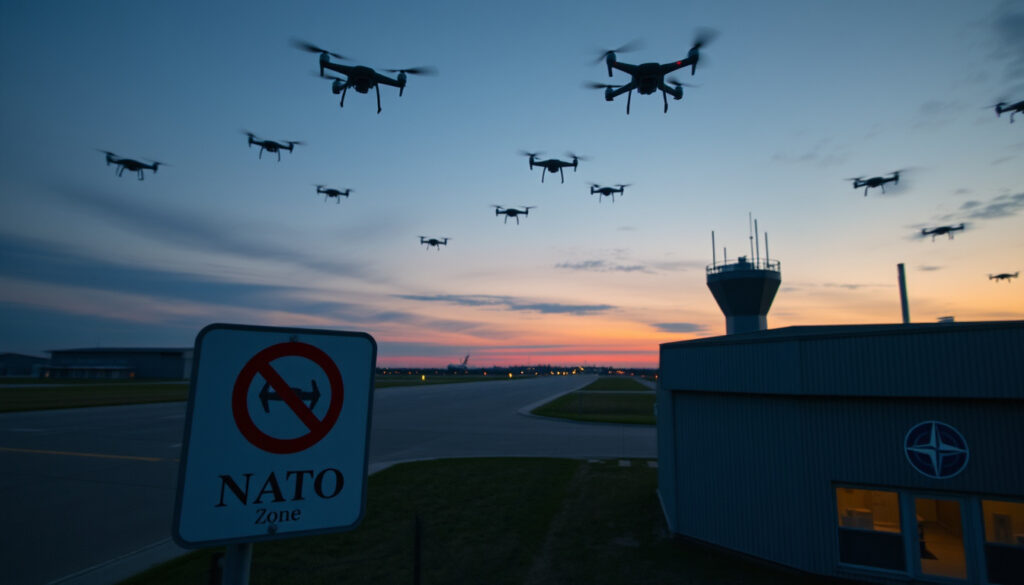
Drone Attacks Denmark Military Bases – Latest Sightings, Ban and NATO Response
In the final days of September 2025, a series of unexplained drone flights over Danish military installations triggered an urgent security response from Copenhagen and NATO. Multiple unidentified aircraft were spotted near armed forces locations, prompting a nationwide ban on civilian drone operations and a stepped-up allied presence in the Baltic Sea. Officials have not confirmed who is behind the incursions, but the pattern has drawn comparisons to suspected Russian reconnaissance activities elsewhere in Europe.
Denmark’s Defence Ministry reported the latest sightings on the morning of 28 September, saying drones had been observed overnight at several military sites. The announcement followed a week of similar incidents that first emerged over Danish airports and later spread to major bases, including Karup air base in central Jutland. The ministry disclosed no details on the number of drones, their size, or their flight paths, and did not attribute the activity to any specific actor.
The developments have raised questions about the vulnerability of NATO’s northern flank and the effectiveness of existing counter-drone measures. With an EU summit scheduled in Copenhagen in early October, Danish authorities moved quickly to eliminate the risk of confusion between hostile drones and legitimate civilian air traffic.
What Happened During the Drone Sightings Over Danish Military Bases?
The incidents unfolded across multiple nights, starting with reports of drones near Danish airports and intensifying with confirmed overflights of military installations. Below is a summary of the key facts as they are known.
Multiple unidentified drones sighted over Danish military bases, including Karup air base, 25–28 September 2025
Denmark banned civilian drone flights; NATO increased Baltic Sea vigilance
Ongoing investigation; no damage reported; origin not officially confirmed
Are the drones Russian? No official attribution, but the pattern matches previous incidents
Key insights from the reported incidents
- The drone sightings represent the most significant incursion over Danish military installations in recent years, triggering immediate policy responses.
- Denmark’s ban on drone flights is a rare, sweeping measure that illustrates the perceived seriousness of the threat.
- NATO’s pledge to step up vigilance in the Baltic Sea region signals a broader concern about hybrid warfare tactics.
- The absence of confirmed attribution — whether state actor, non-state group, or individuals — creates information vacuums that fuel speculation.
- The incidents fit a pattern of suspicious drone activity near NATO bases across Poland, Romania, and now Denmark, suggesting possible coordinated reconnaissance.
Snapshot of the known facts
| Field | Details |
|---|---|
| Date range | 25–28 September 2025 |
| Locations | Karup air base, multiple installations in Jutland |
| Number of drones | Unspecified (multiple sightings per night) |
| Reported damage | None reported |
| Official confirmation | Danish Defence Ministry confirmed sightings |
| Flight bans | Countrywide ban on drone flights from 28 September |
| NATO response | Increased vigilance, monitoring in Baltic Sea |
| Attribution status | Unconfirmed; Russia suspected but not officially blamed |
Why Did Denmark Ban Drone Flights After the Sightings?
On 28 September, Denmark’s Transportation Ministry announced that all civilian drone flying in Danish airspace would be prohibited from Monday to Friday. The measure was intended to reduce the risk of confusion between enemy drones and lawful drones, according to the ministry. Violating the ban could lead to a fine or imprisonment for up to two years.
Who is exempt from the ban?
The restriction does not apply to military drones, state aviation, police and emergency drone operations, or municipal and regional emergency and health-related drone flights. This carve-out ensures that critical services and national security operations remain unaffected while the general airspace is cleared of potential clutter.
Why a blanket ban?
Authorities have noted that many unconfirmed public reports of possible sightings were flooding in, making it difficult to distinguish genuine threats from false alarms. By grounding all civilian drones, the government aimed to simplify detection and response for defence and law enforcement agencies. The ban was also timed ahead of an EU summit in Copenhagen, where security concerns were already elevated.
The ban covers all civilian drone flights across Denmark. Exceptions exist only for military, state, police, emergency, and health-related drone operations. Anyone violating the ban risks a fine or up to two years in prison, as stated by Denmark’s Transportation Ministry.
What Is NATO’s Response to the Drone Incidents in the Baltic Sea Region?
Following a NATO meeting in Riga, the alliance announced it would conduct “even more enhanced vigilance” with new multi-domain assets in the Baltic Sea region, including Denmark. This effort falls under the existing Baltic Sentry framework, a NATO initiative focused on maritime and air security in the Baltic Sea area.
What does stepped-up vigilance mean in practice?
NATO did not disclose specific operational details, but enhanced vigilance typically involves increased aerial surveillance, additional radar coverage, and a higher readiness posture for air defence units. The Baltic Sentry mechanism allows NATO to deploy assets rapidly across member states in the region. The Danish incidents have now been folded into this broader monitoring effort.
Why is the Baltic Sea a focus?
Since Russia’s full-scale invasion of Ukraine in 2022, the Baltic Sea has become a front line for hybrid warfare activities, including suspected GPS jamming, undersea cable sabotage, and drone incursions. The region borders several NATO members — Poland, Lithuania, Latvia, Estonia, and Denmark — as well as Russia’s Kaliningrad exclave. Any unauthorised drone activity near military bases is treated as a potential reconnaissance operation.
For a deeper look at the alliance’s posture in the region, see the guide on NATO’s Baltic Sea Security Posture in 2025.
Are the Drones Over Danish Bases Linked to Russia?
The question of responsibility remains the most sensitive and uncertain aspect of the episode. Denmark’s prime minister and NATO’s secretary-general have both stated that Russian involvement cannot be ruled out. The Russian Embassy in Denmark, however, has denied any role in the incidents.
What is the evidence for Russian involvement?
No direct evidence has been made public. The suspicion rests largely on the pattern of activity: repeated overflights of military sites, the use of multiple drones in a coordinated manner, and the timing ahead of a major EU summit. Similar patterns have been observed in Poland and Romania, where Russian-linked drones — including Shahed 136 loitering munitions — have crossed into NATO airspace. However, no weaponised drones or explosive payloads have been reported in the Danish case.
Could these be UAPs or something else?
While some internet speculation has used the term UAP (Unidentified Aerial Phenomena), no official source has classified these sightings as extraterrestrial. Danish and NATO authorities are treating them as potential security threats of terrestrial origin, most likely reconnaissance drones operated by a state actor or a proxy group. The military’s response — a nationwide drone ban and a request for public reports — is consistent with a counter-intelligence and force-protection operation, not a scientific investigation of anomalous phenomena.
Neither the Danish government nor NATO has officially blamed Russia for the drone flights. Statements from officials indicate that Russian involvement is a possibility, not a conclusion. The Russian Embassy in Denmark has denied any involvement. The investigation is ongoing, and no definitive attribution has been made public.
The absence of confirmed attribution creates an information vacuum. Without knowing who operated the drones or what their objective was, authorities cannot tailor their response — whether diplomatic, military, or legal. This uncertainty also fuels public speculation and complicates efforts to assess whether the incidents were a one-off provocation or part of a larger campaign.
What Is the Timeline of the Drone Sightings in Denmark?
The sequence of events, based on official statements and media reports, is as follows:
- 25 September 2025: First reports of drones over Danish airports and military bases in Jutland. BBC News publishes initial analysis of the incidents.
- 27 September 2025: Large drone sightings at Karup air base and other military installations. The Danish Defence Ministry confirms the sightings. After a meeting in Riga, NATO announces stepped-up vigilance in the Baltic Sea region.
- 28 September 2025: Denmark imposes a nationwide ban on civilian drone flights. Aljazeera and Fox News report on the ban and the Karup air base incident.
- Ongoing: The investigation continues. No official attribution has been made. Danish authorities ask the public to report any suspicious drone activity to the police.
What Is Known and What Remains Unclear About the Drone Incidents?
Separating established facts from ongoing uncertainties is essential for understanding the situation.
| Established information | Information that remains unclear |
|---|---|
| Unidentified drones were sighted over Danish military bases on multiple occasions between 25 and 28 September 2025. | The origin of the drones is not officially confirmed; Russian involvement is widely speculated but not proven. |
| The Danish Defence Ministry confirmed the sightings. | The exact number of drones and their capabilities (range, payload, autonomy) are unknown. |
| Denmark implemented a nationwide drone flight ban. | Whether the drones were operated by a state actor, non-state group, or individuals is unclear. |
| NATO announced increased vigilance in the Baltic Sea region. | The purpose of the incursions — reconnaissance, provocation, or testing — remains unconfirmed. |
| No damage or injuries were reported. | It is not known whether the drones carried any payloads or were purely surveillance platforms. |
How Do the Denmark Drone Sightings Fit Into the Broader European Context?
The Danish incidents are not occurring in isolation. Over the past two years, NATO member states in Eastern Europe have reported repeated drone intrusions near military infrastructure. In Poland, unidentified drones have been observed near logistics hubs used for arms transfers to Ukraine. In Romania, fragments of Shahed 136 drones — Iranian-designed, Russian-operated loitering munitions — have been found on several occasions since 2023.
What sets the Danish case apart is the geographical shift: the sightings occurred in Scandinavia, far from the Ukrainian border, and over a country that is not a direct transit hub for military aid. This suggests that if the drones are part of a coordinated effort, the operational reach of the actors involved may be wider than previously assumed. The Baltic Sentry initiative was specifically designed to address this kind of cross-domain hybrid threat.
For a broader overview of the trend, see the guide on Unidentified Drones in Europe: A Comprehensive Guide.
What Official Statements Have Been Made About the Drone Sightings?
Several official statements have been issued by Danish and NATO authorities. Below are the key quotes reported by media organisations.
“Confirmed that drones were sighted near multiple military installations overnight.”
— Danish Defence Ministry, as reported by multiple news outlets
“Unidentified drones were seen near the country’s military installations overnight.”
— Danish Armed Forces, as quoted by The Guardian
“NATO is monitoring the situation and has stepped up vigilance in the Baltic Sea region.”
— NATO official, as quoted by Fox News
What Is the Current Status of the Investigation?
Danish authorities, supported by NATO, are continuing their investigation into the origin and purpose of the drone flights. No damage or injuries have been reported, and no arrests have been made in connection with the incidents. The civilian drone ban remains in effect, and the public has been asked to report any suspicious activity to the police. The outcome of the investigation will likely shape both Denmark’s domestic counter-drone policy and NATO’s broader posture in the Baltic Sea region.
Frequently Asked Questions
Are the drones in Denmark UAPs?
While some internet speculation has used the term UAP (Unidentified Aerial Phenomena), no official source has classified these sightings as extraterrestrial. The military is treating them as potential security threats, likely of terrestrial origin.
What are Danish military drones?
The phrase “Danish military drones” in this context refers to unmanned aircraft operated by the Danish armed forces for reconnaissance or training. The recent sightings are of unauthorized, unknown drones — not Danish military assets.
Where can I find a map of the drone attacks?
No official interactive map of the exact flight paths has been released. Google Maps and open-source intelligence (OSINT) channels may circulate approximate locations. For authoritative information, check updates from the Danish Defence Ministry.
What is a Shahed 136 drone?
The Shahed 136 is a one-way attack drone (loitering munition) used extensively by Russia in Ukraine. It is not confirmed to be involved in the Denmark incidents, but its presence in other European countries has raised concern.
Can civilians still fly drones in Denmark?
As of 28 September 2025, Denmark has banned all drone flights nationwide. Exceptions may apply for government or emergency services. Check the Danish Transport Authority for updates.
More related posts
 Pauline Collins – Shirley Valentine Star Dies at 85
 Alexej Manvelov – Biography, Career, and Personal Life
 Andrew Mountbatten-Windsor – Epstein Scandal, Life, Fall
 Sam Cooke – The Life, Death, and Legacy of the King of Soul
 Liam Lawson – Net Worth, Salary, Age and Career Stats
 Cass Elliot – The Truth Behind the Death Myths and Her Lasting Legacy
 Dexter Resurrection Episode Guide – Season 1 Schedule, Cast and Dates
 Matt Berry – Biography, TV Shows, Music and Distinctive Voice