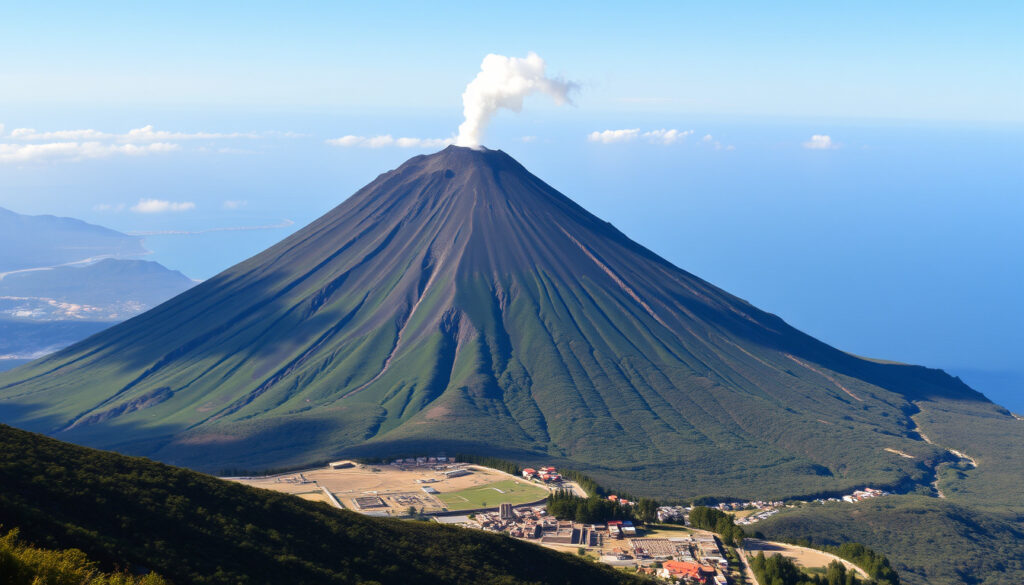
Vesuvius Volcano – Facts, Activity, and Visiting Guide
Mount Vesuvius is an active stratovolcano in Campania, Italy, best known for the AD 79 eruption that destroyed Pompeii, Herculaneum, Oplontis, and Stabiae. It also erupted again in 1944, and it remains one of the world’s most closely monitored volcanic systems.
The volcano rises above the Bay of Naples in one of Europe’s most densely populated regions. Its name is inseparable from the Roman cities sealed beneath the ash, yet its geological history stretches back far beyond that single catastrophe.
Since 1944 Vesuvius has been quiet but not inactive. It continues to shape how volcanologists understand explosive eruptions and remains a central reference point for volcanic risk planning in Italy.
When Did Mount Vesuvius Last Erupt?
The most recent confirmed eruption of Mount Vesuvius took place in . That event is the principal reason Vesuvius is classified as active rather than extinct, according to geological summaries of the volcano’s history.
Several facts give Vesuvius its particular significance:
- Vesuvius is one of the most dangerous volcanoes in the world because of the densely populated area surrounding it; more than 3 million people live in the broader danger zone.
- The 79 AD eruption was a Plinian eruption that produced a roughly 20-km-high eruption column and deadly pyroclastic surges.
- The volcano is currently in a state of repose, yet seismic, gas, and ground-deformation monitoring is constant.
- Visiting Vesuvius requires an advance ticket purchase and a moderate hike; no vehicle access reaches the crater.
- The 1944 eruption was relatively small (VEI 3) compared with earlier activity, but it still destroyed two villages.
Mount Vesuvius Fast Facts
| Fact | Detail |
|---|---|
| First recorded eruption | 79 AD, though the volcano is much older |
| Known eruptions | Over 50 major eruptions in historical times |
| Monitoring agency | Osservatorio Vesuviano (INGV) |
| National park | Vesuvius National Park, established 1995 |
| Crater access ticket (2024) | About €15 online, plus optional guide |
| Volcanic type | Stratovolcano (Somma-Vesuvius complex) |
| Height | 1,281 m (4,203 ft) |
| Status | Active; dormant since 1944 |
The Catastrophic 79 AD Eruption (Pompeii & Herculaneum)
The AD 79 eruption began on 24 August according to the long-standing historical tradition, though some scholarship argues for a later date in autumn based on archaeological and textual evidence. The eruption produced a huge column of ash, pumice, and volcanic gases, followed by pyroclastic flows and surges that buried Pompeii and nearby towns.
The eruption did not come without warning. The region had experienced earthquakes for years, including a major quake in AD 62, suggesting the system was already restless.
Pompeii was not destroyed in a single blast. Falling pumice and ash accumulated through the day, collapsing roofs across the city, before deadly pyroclastic surges swept through and caused many deaths through asphyxiation and thermal shock. Herculaneum, lying closer to the volcano, was buried more deeply by hot pyroclastic material.
The archaeological preservation of Pompeii comes from this burial: volcanic deposits sealed buildings, artifacts, and some victims in place. The most famous eyewitness account comes from the ancient writer Pliny the Younger, whose description of a column shaped like an umbrella pine gave volcanology the term Plinian eruption. For a detailed account of that day, the section on the 79 AD eruption and Pompeii brings the sequence together.
The 1944 Eruption: The Most Recent Activity
Vesuvius erupted again in March 1944, during the final phase of the Second World War. Lava flows and ash fall hit several towns, including San Sebastiano al Vesuvio, and about 27,000 people were evacuated. No casualties were recorded.
The 1944 eruption was relatively small at VEI 3 compared with the volcano’s larger historical events, but it still destroyed two villages. It remains the most recent confirmed eruption and a major reason Vesuvius is classified as active.
Historical Eruption Cycle and Frequency
Vesuvius has produced more than 50 major eruptions in historical times. Among the most significant are the 1631 eruption, which destroyed towns at the base of the mountain and killed thousands, and the 1794 eruption, when lava flows reached Torre del Greco and caused around 2,000 reported deaths.
The 1906 eruption was larger still, with lava fountains and damaging ash fall, though evacuations kept casualties lower. Periods of apparent dormancy have often been long. Britannica describes Vesuvius as a relatively young volcano that had been dormant for centuries before the AD 79 event.
Is Mount Vesuvius Still an Active Volcano?
Yes. Volcanologists classify Vesuvius as active rather than extinct or merely dormant. The 1944 eruption ended a long period of quiet, and the volcano has remained under continuous observation ever since.
Vesuvius Today: Seismic Activity and Fumaroles
The Vesuvius Observatory (INGV) monitors the volcano around the clock. Networks of seismometers, GPS instruments, gas analyzers, and thermal cameras track background seismicity, ground deformation, and gas emissions.
At present, the volcano is in a state of repose, with no immediate signs of eruption. This quiet period is consistent with its long history of intermittent activity.
Volcanic Alert Level and Emergency Plans
Italy’s civil protection system manages volcanic risk through color-coded alert levels, from green through yellow and orange to red. The Italian Civil Protection has published evacuation plans for the Vesuvius red zone, the area most exposed to pyroclastic flows and ash fall.
Approximately 600,000 people live in the immediate red zone, while more than 3 million reside in the broader danger area around Naples and Campania.
Vesuvius is not a casual mountain hike; it is an active volcanic hazard zone with a history of sudden explosive eruptions. Stay on marked paths, follow ranger or park instructions, and leave immediately if volcanic alerts are issued.
Can Vesuvius Erupt Again? Scientific Predictions
Volcanologists agree that Vesuvius will erupt again, but exactly when remains unknown. The Smithsonian Global Volcanism Program records Vesuvius as the only volcano on the Italian mainland to have erupted during the last 100 years, reinforcing its active status.
Past behaviour offers only a rough guide. A future eruption could be similar in scale to 1944 or considerably larger, as in 1631. Monitoring and emergency planning are designed to manage that range of possibilities.
How Can I Visit Mount Vesuvius? (Tickets, Hiking, and Tours)
Vesuvius is a major tourist destination, and most visitors reach the crater rim on foot. The mountain lies within Vesuvius National Park, and access is managed through official channels.
Buying Mount Vesuvius Tickets: Online vs On-Site
Access to the crater trail is ticketed. Tickets cost about €15 for standard crater access when purchased online, and advance booking is strongly recommended during peak season. The official ticket system operates through the Parco Nazionale del Vesuvio website.
On-site ticket availability is not guaranteed, and trail openings, operating hours, and conditions can change with volcanic or weather activity. Checking official channels before setting out is the safest approach.
Hiking the Gran Cono Trail to the Crater
The main route to the crater is the Gran Cono trail, a moderate hike that typically takes two to three hours round trip. The path is loose volcanic gravel in places, with exposed and steep sections, and the crater edge can be unstable. No vehicle access reaches the crater.
Sturdy footwear, water, sun protection, and a jacket for wind are recommended. The crater area can involve heat, strong wind, and crowding, so extra caution is warranted. For current guidance on trail access and conditions, see the notes on Hiking and visiting Vesuvius.
Because Vesuvius is an active volcano, access can be subject to closures or restrictions when conditions change. Plan your visit through official park channels rather than improvising on the spot.
Guided Tours and Combinations with Pompeii
Half-day and full-day tours from Naples, Sorrento, and the Amalfi Coast commonly combine Vesuvius with the nearby Pompeii Archaeological Park. Organized tours typically include transport by bus or minivan, a guide, and timed entry to both sites.
Seeing Pompeii and Vesuvius in one day is feasible, but it requires an early departure and careful attention to entry times.
What Is the Geology of Mount Vesuvius?
Vesuvius: A Stratovolcano Within an Ancient Caldera
Vesuvius is a stratovolcano, built up by layered eruptions of ash, pumice, lava, and other volcanic materials. It stands within the Somma-Vesuvius complex, where the older Mount Somma forms the eroded rim of a caldera and the newer Vesuvius cone grew inside it. The caldera formed around 3,800 years ago after a massive eruption known as the Avellino eruption.
The summit of Vesuvius currently reaches 1,281 m (4,203 ft).
Volcanic Composition and Eruption Styles
Vesuvius sits on the Campanian volcanic arc, a subduction zone where the African plate slides beneath the Eurasian plate. Its magma is rich in potassium, which contributes to highly explosive eruptions.
The AD 79 eruption sent material tens of kilometres into the air and produced widespread ash fall and pyroclastic density currents. This Plinian style of eruption, named after Pliny the Younger, is the most hazardous type associated with Vesuvius. Later eruptions have also produced lava flows, as seen in 1794 and 1944.
The Vesuvius Observatory (INGV) monitors the volcano with networks of seismometers, GPS instruments, gas analyzers, and thermal cameras, tracking ground deformation and gas emissions alongside seismic activity.
How Often Has Mount Vesuvius Erupted?
Vesuvius has erupted more than 50 times in historical records. The most significant events, compiled from volcanological and historical sources, are listed below.
- c. 3,800 years ago — Formation of the Somma caldera after the massive Avellino eruption.
- 79 AD — Cataclysmic Plinian eruption buries Pompeii, Herculaneum, and Stabiae; Pliny the Elder dies; more than 10,000 estimated casualties.
- 1631 — Violent eruption destroys towns at the base; pyroclastic flows kill thousands.
- 1794 — Lava flows reach Torre del Greco; around 2,000 deaths reported.
- 1906 — Large eruption with lava fountains; ash fall causes widespread damage, but evacuations keep casualties lower.
- — Last eruption to date; lava flows and ash fall; no casualties, but about 27,000 people evacuated.
These records draw on institutional sources including Britannica, the Smithsonian Global Volcanism Program, INGV, and dedicated historical studies of the 1631 and 79 AD eruptions.
What Is Certain and What Remains Uncertain About Vesuvius?
The history of Vesuvius is well documented, but not every detail is settled. Separating established facts from open questions helps clarify what scientists can and cannot predict.
Established information
- Vesuvius is an active volcano; it will erupt again.
- The 79 AD eruption destroyed Pompeii and Herculaneum.
- The last eruption was in March 1944.
- The volcano is monitored around the clock by INGV.
Information that remains unclear
- Exactly when the next eruption will occur is unknown.
- The precise magnitude of the next eruption cannot be forecast in advance.
- Some details of the 79 AD sequence, including the exact number of victims, remain uncertain; estimates vary across sources.
- The precise date of the 79 AD eruption is debated between 24 August and a later autumn date.
Why Does Vesuvius Matter Beyond Its History?
Mount Vesuvius sits on the Campanian volcanic arc, a subduction zone formed by the African plate sliding under the Eurasian plate. Its potassium-rich magma produces highly explosive eruptions, making it one of the most dangerous volcanic systems in Europe.
The 79 AD eruption was the first well-documented volcanic disaster in history, thanks to Pliny the Younger’s letters, and it gave volcanology the term “Plinian eruption.” Today, Vesuvius is one of three active volcanic centres threatening Naples, alongside Campi Flegrei and Ischia.
Emergency planning divides the surrounding red zone into sectors for staged evacuation. Public awareness campaigns are ongoing, though many locals have become complacent during decades of quiet.
Which Sources Tell Us About Vesuvius?
Knowledge of Vesuvius comes from a mix of ancient letters, volcanological records, and continuous monitoring data.
“…a cloud… from which could be seen a strange and terrifying sight: from the top of the mountain a column of smoke… like an umbrella pine.”
Pliny the Younger, Letters 6.16 & 6.20
“Vesuvius is the only volcano on the Italian mainland to have erupted during the last 100 years.”
Smithsonian Global Volcanism Program
“Vesuvius is monitored with networks of seismometers, GPS instruments, gas analyzers, and thermal cameras.”
INGV (Osservatorio Vesuviano)
These three layers of evidence — historical, institutional, and instrumental — together explain why Vesuvius is considered one of the best-understood volcanoes on Earth.
What’s Next for Mount Vesuvius?
Scientific research continues to improve forecasting methods. A future eruption could be relatively small, like the 1944 event, or large, like the 1631 eruption. The Italian government has updated evacuation plans and published hazard maps for the surrounding region. While monitoring remains at green level, tourists can still safely visit the crater.
Frequently Asked Questions About Mount Vesuvius
What is the difference between Vesuvius and Mount Somma?
Mount Somma is the older, eroded rim of a caldera. Vesuvius is the newer cone that grew inside that caldera. Together they form the Somma-Vesuvius complex.
Were there any warning signs before the 79 AD eruption?
Historical records mention minor earthquakes in the preceding days, but the scale of the eruption was not anticipated.
How many people live in the Vesuvius red zone?
Approximately 600,000 people live in the immediate red zone, while more than 3 million reside in the broader danger area.
Can I visit Vesuvius without a ticket?
No. Access to the crater trail is ticketed; you must buy a ticket, and purchasing online is recommended.
What should I wear when hiking Vesuvius?
Sturdy shoes, sun protection, water, and a jacket for windy conditions. The path is volcanic gravel and loose stones.
More related posts
 Frank Abagnale Jr – True Story, Crimes, Family & Net Worth
 Mr T – Real Name, Age, Net Worth, and Wife
 Patsy Palmer – Full Biography from EastEnders to Malibu
 Richard Madeley – Age, Net Worth, Wife, and Latest Career News
 James Watt – The Inventor and the BrewDog Founder
 Daisy Edgar-Jones – Normal People, Where the Crawdads Sing and Her Career
 Dome of the Rock – History, Interior and Religious Significance
 James O’Brien – LBC Host and Bestselling Author