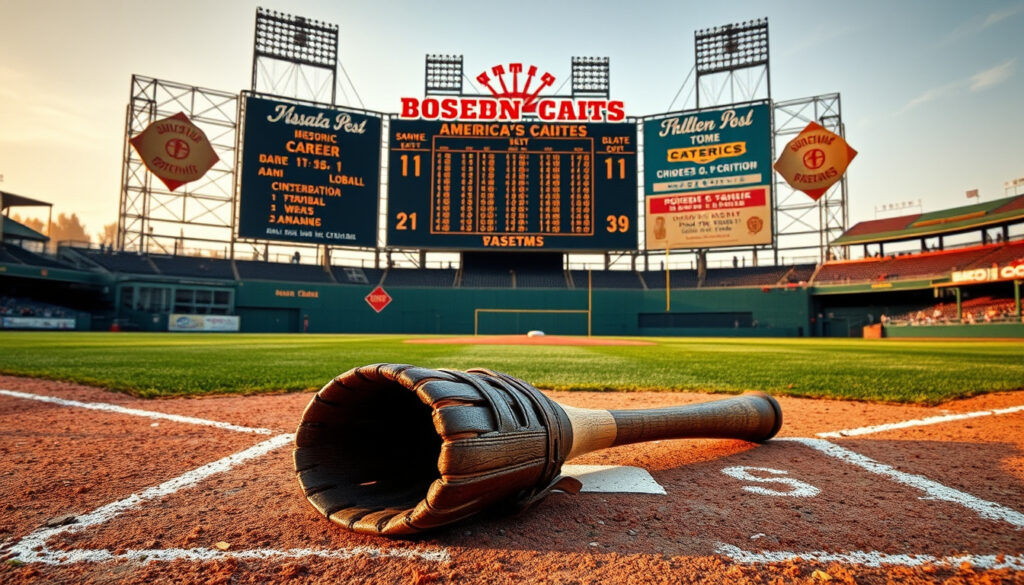
Babe Ruth – Career Stats, Biography and Baseball Legacy
Babe Ruth was an American baseball player whose extraordinary power helped transform Major League Baseball during the 1920s. He made his name first as an elite left-handed pitcher for the Boston Red Sox, then rewrote the sport’s offensive records as a right fielder for the New York Yankees.
Born George Herman Ruth Jr. in Baltimore, he spent part of his childhood at St. Mary’s Industrial School for Boys, where Brother Matthias encouraged and developed his baseball abilities. He entered the major leagues in 1914 with the Boston Red Sox. After the Yankees acquired him before the 1920 season, his home-run production helped create an offensive revolution and drove the sport’s popularity through the decade.
His records, his health, and his family background all remain points of reference for new generations of fans.
Babe Ruth Stats
Few players can be measured the way Ruth can, because he excelled on both sides of the game. From 1915 through 1919, he won 87 games with a 2.16 earned-run average and won three World Series games for Boston. He then became primarily an outfielder and changed what fans expected from a hitter.
- Ruth was an elite pitcher before becoming the game’s most famous slugger; his 94–46 record and 2.28 ERA remain exceptional.
- His 714 career home runs reset the sport’s expectations and made him a national cultural icon during the live-ball era.
- His .690 career slugging percentage is still the major-league record, along with the .847 single-season mark he set in 1920.
- He won seven World Series championships, three with Boston and four with New York.
- He was the American League home-run leader 12 times.
- His career straddled the dead-ball and live-ball eras, and his power hitting made the home run a central part of baseball’s appeal.
- His baseball cards, especially prewar issues, remain among the most valuable collectibles in the hobby.
| Fact | Detail |
|---|---|
| Full name | George Herman Ruth Jr. |
| Born | February 6, 1895, Baltimore, Maryland |
| Died | August 16, 1948, New York City |
| Height | 6 ft 2 in |
| Weight | 215 lb |
| Batted / Threw | Left / Left |
| MLB teams | Boston Red Sox (1914–1919), New York Yankees (1920–1934), Boston Braves (1935) |
| Career batting average | .342 |
| Career home runs | 714 |
| Career RBIs | 2,214 |
| Career pitching record | 94–46 |
| Hall of Fame | Inducted 1936 |
Ruth’s honors stretch across both roles. He hit 15 home runs in World Series play, a record for many years. His 714 career home runs stood until Hank Aaron hit his 715th in 1974, and his 60 home runs in 1927 remained the single-season record until 1961. He led the American League in home runs 12 times.
His career on-base percentage of .474 and his career slugging percentage of .690 remain benchmarks. Ruth also stole 123 bases and finished with a 94–46 pitching record and a 2.28 ERA.
| Category | Career total |
|---|---|
| Batting average | .342 |
| Home runs | 714 |
| Runs batted in | 2,214 |
| Runs scored | 2,174 |
| Hits | 2,873 |
| On-base percentage | .474 |
| Slugging percentage | .690 |
| OPS | 1.164 |
| Stolen bases | 123 |
| Pitching wins | 94 |
| Pitching losses | 46 |
| Pitching ERA | 2.28 |
Some statistical databases differ slightly in categories such as RBI because official record-keeping practices varied during Ruth’s era. Career totals in the table follow the record compiled by Baseball Reference.
Babe Ruth Baseball Card Guide
Babe Ruth cards can be worth anywhere from hundreds of dollars to several million dollars. The range depends on the card’s year, rarity, condition, authenticity, grading, and documented sales history.
- 1914 Baltimore News Babe Ruth: Among the most valuable baseball cards ever produced; exceptionally rare examples have sold for millions.
- 1933 Goudey Babe Ruth cards: Highly desirable vintage cards; lower-grade examples may sell for hundreds or thousands, while high-grade examples can reach six figures or more.
- 1932 U.S. Caramel Babe Ruth cards: Rare and valuable, especially in high condition.
- 1933 Goudey “Yellow Ruth” and “Red Ruth”: Popular cards whose value varies greatly by card number, centering, surface quality, and professional grade.
- Later 1940s and 1950s Ruth cards: Usually less expensive than prewar issues but can still command substantial prices in high grade.
- Modern commemorative cards: Typically worth much less unless limited, autographed, game-used, or exceptionally rare.
A reliable valuation requires identifying the exact card and checking a reputable grading company or auction database. The year, manufacturer, card number, front and back design, condition, dimensions, and whether the card has been professionally graded all matter. A photograph alone is not enough to authenticate a valuable Ruth card.
Condition and rarity drive Ruth card prices, and those prices move with the collector market. For popular issues such as the 1933 Goudey set, lower-grade Ruth cards may sell for hundreds or thousands, while high-grade examples reach six figures or more.
How Old Was Babe Ruth When He Died?
Babe Ruth died at 53. He was born on February 6, 1895, in Baltimore, and died on August 16, 1948, in New York City.
What Was Babe Ruth’s Cause of Death?
Ruth died from cancer, specifically an inoperable malignant tumor involving the base of his skull and neck. Before doctors diagnosed the tumor in 1946, he had experienced severe pain near his left eye and difficulty swallowing.
The disease was associated with the serious health decline visible during his final years. Ruth made his last public appearance at Yankee Stadium on April 27, 1947, and died the following year.
Ruth began treatment after a malignant tumor was found in 1946. The cancer was considered inoperable, and his health continued to decline until his death in August 1948.
How Tall Was Babe Ruth?
During his playing career, Ruth was generally listed at 6 feet 2 inches tall and approximately 215 pounds. His weight increased substantially later in life.
What Ethnicity Was Babe Ruth?
Ruth was of German-American ancestry. Both of his parents came from working-class German families, and he grew up around Pennsylvania Dutch relatives. He reportedly spoke some German as a child.
The term “Pennsylvania Dutch” refers historically to German-speaking immigrants and their descendants. “Dutch” in this context derives from the German word “Deutsch,” not from the Netherlands.
What Are Babe Ruth Facts for Kids?
Young readers usually meet Ruth through a short set of facts that capture his place in baseball history.
A “slugger” is a powerful hitter. “The Sultan of Swat” and “The Bambino” were two of Ruth’s most famous nicknames.
- Babe Ruth’s real name was George Herman Ruth Jr.
- He first became famous as a pitcher before becoming baseball’s greatest home-run hitter.
- He played for the Boston Red Sox and New York Yankees.
- The Yankees’ ballpark became known as “The House That Ruth Built” because his popularity helped drive attendance.
- He hit 60 home runs in 1927.
- He hit 714 home runs during his career.
- He helped the Yankees win four World Series championships.
- He was one of the first players inducted into the Baseball Hall of Fame.
- He attended St. Mary’s Industrial School, where Brother Matthias helped teach him baseball.
- His parents operated a tavern in Baltimore.
Babe Ruth Pictures
Ruth’s celebrity made him one of the first athletes to cross into mainstream American popular culture. That status explains why photographs of him remain a major part of baseball’s visual history.
Historical photo collections document Ruth from his early Red Sox seasons through his final MLB season with the Boston Braves. Public-domain repositories such as the Library of Congress and the National Archives hold much of that material and allow reproduction without copyright risk.
What Were the Key Dates in Babe Ruth’s Life?
The key dates in Ruth’s life run from his birth in Baltimore to his Hall of Fame induction and death in New York.
- : Born in Baltimore. George Herman Ruth Jr. is born to German-American parents.
- : Sent to St. Mary’s Industrial School. Ruth’s baseball ability is developed during his years at the Baltimore institution.
- : Professional debut. Ruth enters professional baseball with the minor-league Baltimore Orioles, spends time with the Providence Grays, and is acquired by the Boston Red Sox.
- : Sold to the New York Yankees. He begins his famous slugging era in New York and transforms the franchise.
- : 60 home runs. He hits a then-record 60 home runs in a single season.
- : The legendary “called shot.” He hits a home run at Wrigley Field after an infamous pointing gesture; details remain disputed.
- : Final MLB season. He ends his playing career with the Boston Braves.
- : Hall of Fame induction. He is elected as one of the first five members of the Baseball Hall of Fame.
- : Cancer diagnosis. Ruth begins treatment after a malignant tumor is found.
- : Death at 53. Babe Ruth dies of cancer in New York City.
Which Babe Ruth Facts Are Certain and Which Are Disputed?
Most of Ruth’s biography is firmly documented. A few details require careful language because the historical record is incomplete or the subject keeps changing.
| Established information | Information that remains unclear |
|---|---|
|
|
Why Does Babe Ruth Still Matter in Baseball History?
Ruth’s career straddled the dead-ball and live-ball eras. His power hitting changed offensive strategy in baseball and made the home run a central form of fan excitement.
He remains one of the only players in MLB history to dominate both as a pitcher and as a position player. His celebrity status made him one of the first athletes to cross into mainstream American popular culture.
The same appetite for athlete stories extends across sports; Justin Hood – Biography, Career and World Championship Run is one recent example.
History.com’s “10 Things You May Not Know About Babe Ruth” collects anecdotes that go beyond the standard biography.
Where Can I Find Reliable Information About Babe Ruth?
For verified biographical information, the National Baseball Hall of Fame and MLB.com are strong starting points. Both publish official profiles that confirm his teams, his induction year, and his place in the game’s history.
Baseball Reference serves as the canonical statistical record for his career totals, and Britannica supplies encyclopedic historical framing. Biography.com documents his family and early life, while public-domain image collections at the Library of Congress and the National Archives are the recommended starting points for photographs.
What Is Babe Ruth’s Lasting Legacy?
Babe Ruth changed how baseball was played and watched. His home-run power defined the live-ball era, his early pitching record gave him a dual athletic legacy, and his cards and photographs still circulate as cultural touchstones. The record-breaking drive he embodied still appears in modern sports, as with Beau Greaves – First Woman Ever to Win a PDC Ranking Title.
More related posts
 Sam Vanderpump – Illness, Transplant Wait and New Baby
 What Is Primary Research – Definition, Methods, Examples and Vs Secondary
 Francis Rossi Status Quo – Retirement, Solo Album and Legacy
 Puerto Rico – Essential Travel Guide and Cultural Insights
 James Ransone – Cause of Death, Wife, Movies and Legacy
 Lauren Holly – Age, Movies, Net Worth, and Marriages in 2025
 Thora Hird – Cause of Death, Family, Career and Lasting Legacy
 Andy Robertson – Biography, Career Stats, Net Worth and Family