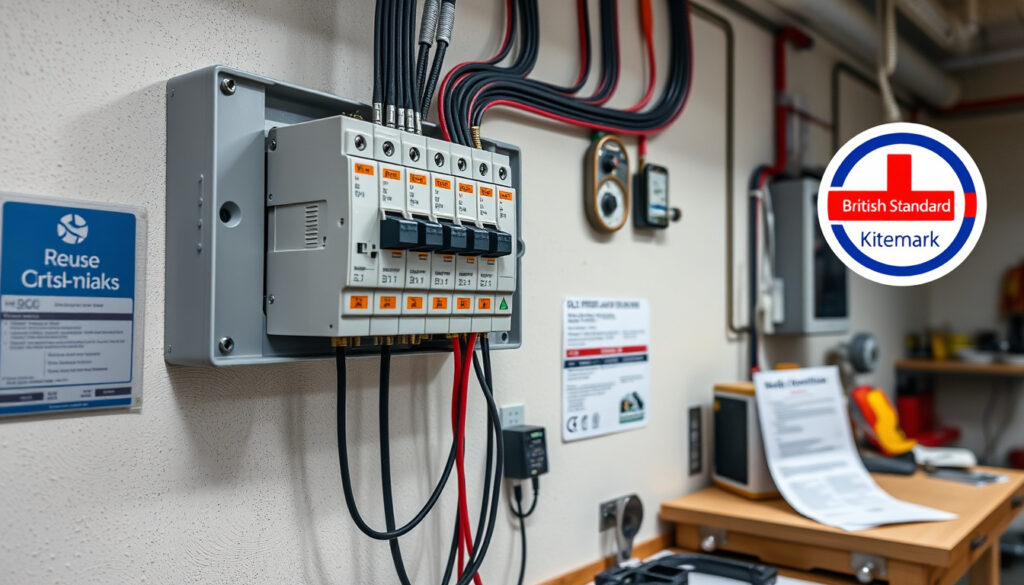
Consumer Unit – UK Guide to Types, Wiring and Regulations
Every home relies on a single piece of electrical equipment that most people rarely think about — the consumer unit. Commonly called a fuse box or fuse board, it is the central hub that distributes electricity from the mains supply to the lighting, sockets, appliances and other circuits throughout a property. Without it, safe and organised electrical distribution would not be possible.
In the UK, the consumer unit has evolved considerably over the past few decades. Older fuse boxes with rewirable fuses have given way to sophisticated units fitted with miniature circuit breakers (MCBs), residual current devices (RCDs), and, more recently, combined residual current breakers with overcurrent protection (RCBOs) and surge protection devices (SPDs). These changes reflect tightening safety standards and a growing awareness of electrical risk in domestic settings.
For anyone buying, replacing or simply understanding a consumer unit in 2025 or 2026, the landscape can seem technical. The 18th Edition Wiring Regulations (BS 7671:2018 + A2:2022) now mandate specific components and materials, and the choice between a dual-RCD unit and a full RCBO board carries both cost and safety implications. This guide brings together the key facts, regulations, costs and purchasing options so that homeowners, landlords and tradespeople can make informed decisions.
What is a Consumer Unit? Understanding the Modern Fuse Box
Definition
A consumer unit (fuse box) distributes electricity from the main supply to circuits, with protective devices to prevent overloads and faults.
Types & Components
Includes main switch, MCBs, RCDs, RCBOs, and SPDs. Options: high-integrity, dual RCD, or fully RCBO-loaded units.
Installation & Safety
Installation must comply with BS 7671 (18th Edition). Professional electrician required unless certified; key steps: isolate, remove old unit, wire, test.
UK Regulations
All domestic consumer units must meet 18th Edition requirements: metal enclosures, RCD protection on most circuits, SPD on new builds.
- Modern consumer units use RCBOs to provide individual circuit protection, eliminating nuisance tripping common with dual-RCD units.
- The 18th Edition wiring regulations mandate metal enclosures for all new consumer units since 2016 to improve fire safety.
- Adding an SPD (Surge Protection Device) to a consumer unit is now required for new installations to protect sensitive electronics.
- Replacing an old fuse box with a new consumer unit can increase home safety and property value, but must be done by a qualified electrician.
| Attribute | Detail |
|---|---|
| Standard Voltage | 230V single-phase (domestic) |
| Typical Number of Ways | 6 to 20 (most common: 10-14 ways) |
| Main Protective Devices | MCB, RCD, RCBO, SPD |
| Regulatory Standard | BS 7671:2018 (18th Edition Wiring Regulations) |
| Compliance Requirement | Part P of Building Regulations (England & Wales) |
| Average Cost (Unit Only) | £40 – £150 (basic) to £200+ (premium with RCBOs) |
| Average Installation Cost (inc. labour) | £300 – £800 depending on complexity |
| Enclosure Material (new installs) | Metal (steel) — plastic units no longer permitted |
| SPD Requirement | Mandatory for new builds and rewires unless risk assessment waives it |
Based on industry averages; exact figures vary by region and electrician.
What is a Consumer Unit RCBO and When Should You Use It?
An RCBO is a single device that combines the functions of a miniature circuit breaker (MCB) and a residual current device (RCD). It protects against both overcurrent (overload and short circuit) and earth leakage currents. Unlike a standard RCD, which monitors a group of circuits together, an RCBO protects each circuit individually.
The practical benefit is significant. In a dual-RCD (split-load) consumer unit, a fault on one circuit — say, a faulty washing machine — can cause the entire RCD block to trip, plunging half the house into darkness. With RCBOs, only the affected circuit is interrupted. Lights, heating and other circuits continue to operate normally.
For 2025/2026 installations in the UK, electricians increasingly recommend full RCBO boards over dual-RCD units. The 18th Edition strongly supports this approach, and the reduction in nuisance tripping alone often justifies the higher upfront cost. For homes with sensitive equipment or occupants who rely on constant power (e.g., for medical devices), RCBOs are particularly valuable.
RCBO vs RCD: Which Offers Better Protection?
RCDs detect earth faults by comparing current flow in the live and neutral conductors. If there is an imbalance — meaning current is leaking to earth — the device trips. This provides crucial protection against electric shock. However, an RCD does not protect against overcurrent; that remains the job of an MCB on each circuit.
An RCBO does both jobs in one unit. It contains the same earth fault detection as an RCD plus the overcurrent sensing of an MCB. According to guidance from the Institution of Engineering and Technology (IET), RCBOs are the recommended standard for new consumer units because they isolate only the faulty circuit, leaving the rest of the installation live. The IET notes that RCBOs are strongly recommended to prevent the nuisance tripping that occurs with traditional RCDs.
How to Choose the Right RCBO for Your Consumer Unit
RCBOs are rated by their current capacity (typically 6A, 10A, 16A, 20A, 32A, 40A or 50A) and their residual current sensitivity (usually 30mA for socket circuits). Type A RCBOs are standard for domestic use, while Type F or Type B may be needed for certain loads like electric vehicle chargers. The unit must also match the brand and range of the consumer unit — not all RCBOs are interchangeable between manufacturers.
Combined RCBO and SPD Consumer Units
Many modern consumer units are designed to accept an integrated SPD module alongside RCBOs. This arrangement provides both surge protection and individual circuit protection in a single metal enclosure. According to trade sources, SPDs integrate best with RCBO boards because the wiring arrangement minimises cable lengths and optimises performance. For new installations in 2025/2026, a combined RCBO + SPD unit is widely regarded as the safest configuration.
Consumer Unit Wiring: A Step-by-Step Guide for Safe Installation
Wiring a consumer unit is a job that must be approached with care. In the UK, any work on a consumer unit is notifiable under Part P of the Building Regulations (England and Wales). Only a qualified electrician registered with a competent person scheme — such as NAPIT — can legally certify the work. DIY installation is permissible in theory, but without certification the installation will not comply with regulations and could cause serious safety or insurance issues.
Replacing a consumer unit is a notifiable job under Part P. It must be carried out by a registered competent person or inspected by building control. DIY is allowed only if the work is subsequently certified and approved.
Preparation and Safety Checks Before Wiring
Before any wiring begins, the supply must be isolated. The main fuse should be removed or the isolation switch turned off. A voltage tester confirms the circuit is dead. All cables must be inspected for damage, and the old consumer unit should be carefully removed without pulling or stressing the cables.
Step-by-Step Wiring Process
The process varies by unit, but the general sequence is: mount the new metal consumer unit, connect the main earth and bonding conductors, terminate the incoming supply tails (via a suitable isolator if required), install the busbar, then connect each circuit to its respective RCBO or MCB/RCD combination. SPDs are wired in parallel with the supply, and the total wiring length between the SPD connection points should not exceed 0.5 metres — and never more than 1.0 metre — to ensure effective protection, as specified in IET guidance. RCBOs are wired directly into the busbar and provide both overcurrent and residual current protection on a single device.
Testing and Certification After Installation
Once all connections are made, each circuit must be tested for continuity, insulation resistance, polarity and earth fault loop impedance. The RCD or RCBO tripping times must be verified. An Electrical Installation Certificate (EIC) is issued, and the work must be notified to the local building control body or registered through a competent person scheme.
Where to Buy a Consumer Unit: Screwfix and Other UK Retailers
For homeowners and tradespeople looking to purchase a consumer unit, the UK market offers several established retailers. Screwfix stocks metal consumer units compatible with RCBOs and SPDs from brands such as Hager, Wylex and BPM. RCBOs and SPD modules are typically sold as separate add-ons rather than pre-assembled kits, so buyers may need to purchase an empty metal unit plus the individual protective modules.
Other suppliers include Electrical4Less and Consumer Unit World. Consumer Unit World claims over 37 years of experience supplying consumer units and circuit protection devices, targeting trade customers. The market is split between budget brands such as Fusebox and Proteus, and premium manufacturers including Hager, Wylex and Schneider.
DIY installation of consumer units is legally restricted in the UK. Even if you buy the unit and components from a retailer, you must be competent to install it or hire a qualified electrician who can certify the work and ensure Part P compliance.
Screwfix Consumer Unit Range
Screwfix typically carries metal consumer units in 10-way and 12-way configurations, RCBO modules (30mA Type A), and Type 1/2 SPD modules. It is worth checking whether a pre-assembled RCBO + SPD unit is in stock — if not, the components must be bought separately. For 2026 pricing, a dual-RCD unit at Screwfix falls in the £380–£520 range, an RCBO-only unit between £520 and £720, and a unit with built-in SPD between £560 and £780, with extra costs of £60–£120 for meter tails and earthing.
Price Comparison: Budget vs Premium Consumer Units
Material costs for a standard 12-way dual-RCD unit are around £60–£150, while a full RCBO unit ranges from £150 to £350. Labour and certification add £350–£550 for dual-RCD and £450–£600 for RCBO installations. Total installation cost for a dual-RCD unit is typically £450–£699; for a full RCBO system it is £600–£950 or more. RCBO systems cost 30–50 per cent more initially but reduce long-term service costs due to fewer nuisance trips, according to trade sources.
Evolution of the Consumer Unit: From Fuse Box to Smart Distribution
- Pre-1970s: Traditional fuse boxes with rewirable fuses (wire fuses). No RCD protection.
- 1980s–1990s: Introduction of MCBs (Miniature Circuit Breakers) replacing wire fuses. Early RCDs added for socket circuits.
- 2008 (17th Edition): RCD protection required for all socket outlets up to 20A. Split-load consumer units become popular.
- 2016 (18th Edition amendment): Metal enclosures become mandatory for consumer units to reduce fire risk.
- 2018 (18th Edition): RCBOs recommended for each circuit; SPDs required for new builds; consumer units must be within 3m of meter or have isolation switch.
- 2020s: Rise of fully RCBO-loaded consumer units, smart units with remote monitoring, and integration with home energy management systems.
RCBOs, RCDs and SPDs: What Is Clearly Known and What Remains Uncertain
| Topic | Established Information | What Remains Unclear |
|---|---|---|
| RCBO vs RCD | RCBO provides both overcurrent and earth fault protection per circuit; RCD only earth fault. RCBOs are recommended for nuisance-trip reduction. | None — this distinction is well established in BS 7671 and IET guidance. |
| DIY Installation Legality | In England & Wales, replacing a consumer unit is notifiable under Part P and must be carried out by a registered competent person (or inspected by building control). DIY is allowed but must be certified. | None — the legal framework is clear. |
| Cost Estimates | Prices vary significantly based on property size, unit type, and electrician rates. The provided ranges are averages from trade sources. | Medium certainty. Exact costs depend on regional labour rates and the specific configuration needed. Homeowners should obtain multiple quotes. |
| Future of Smart Consumer Units | Smart units are emerging but not yet mainstream in domestic UK applications. | Low to medium certainty. Standardisation is still evolving, and long-term reliability data for smart consumer units in UK homes remains limited. |
| SPD Requirement | SPDs are required for most domestic installations since September 2022 (Amendment 2), unless a written risk assessment proves it unnecessary. | None — the regulation is clearly stated in BS 7671. |
Why the Consumer Unit Market Is Changing: Context and Background
The shift from fuse boxes to modern consumer units reflects decades of rising safety standards. The 18th Edition of the Wiring Regulations has driven the adoption of RCBOs and SPDs, creating demand for higher-end units with better protection. Metal enclosures, required since 2016, have eliminated the fire risk associated with old plastic units.
The market is fragmented between budget brands such as Fusebox and Proteus and premium manufacturers like Hager, Wylex and Schneider. Retailers such as Screwfix and Electrical4Less cater to both trade buyers and competent DIYers. Consumer awareness of electrical safety has grown, leading more homeowners to proactively replace outdated fuse boxes. However, the cost of a full RCBO installation — typically £600–£950 — remains a barrier for some.
Looking ahead, the growing interest in electric vehicles (EVs) will influence consumer unit design. Dedicated high-current circuits and load management features are likely to become standard. Upcoming amendments to BS 7671 — possibly around 2025 — may introduce requirements for arc fault detection devices (AFDDs) in more settings, further increasing the complexity and capability of domestic consumer units.
What Official Sources Say About Consumer Unit Safety and Standards
“Consumer units have been called many different names over the years, such as fuse box, fuse board and dis-board. They are typically installed in domestic premises and provide a means of distributing electrical energy to circuits.”
— Institution of Engineering and Technology (IET), Consumer Unit Guidance
“Regulation 421.1.201 requires that consumer units shall comply with BS EN 61439-3 and be enclosed in a non-combustible material (metal enclosure).”
— BS 7671:2018 (18th Edition Wiring Regulations)
“We have over 37 years of experience in supplying consumer units, 3 phase fuseboards and circuit protection devices.”
— Consumer Unit World
The IET provides the most authoritative public guidance on consumer units, covering definitions, safety and regulatory compliance. The UK Government also publishes resources on electrical safety in the home, and the British Standards Institution holds the definitive text of BS 7671, the 18th Edition Wiring Regulations.
What Homeowners Should Know About Consumer Units in 2025 and Beyond
For anyone planning a consumer unit replacement or new installation in 2025 or 2026, the key points are clear. The unit must have a metal enclosure, include an SPD (unless formally waived by risk assessment), and use RCBOs for individual circuit protection rather than traditional dual-RCD split loads. Professional installation by a qualified electrician is required for Part P compliance and certification. The average total cost for an RCBO unit with SPD is between £600 and £950, depending on property size and electrician rates.
Frequently Asked Questions About Consumer Units
How much does a consumer unit replacement cost?
For a standard 12-way unit, expect £450–£699 for a dual-RCD system or £600–£950 for a full RCBO installation, including labour and certification. Prices vary by region and property complexity.
Can I replace a consumer unit myself?
DIY replacement is legally allowed but must be certified under Part P. In practice, most homeowners hire a registered electrician to ensure compliance and safety.
What is the difference between an MCB and an RCBO?
An MCB protects against overcurrent only. An RCBO combines overcurrent and earth fault (residual current) protection in one device, replacing both an MCB and an RCD.
What is an SPD and do I need one?
A Surge Protection Device protects appliances from voltage spikes. Since September 2022, SPDs are required for most new domestic installations unless a written risk assessment concludes they are unnecessary.
How many ways do I need in my consumer unit?
Most UK homes need 10 to 14 ways. Count your circuits (lighting, sockets, cooker, shower, etc.) and allow 2–4 spare ways for future additions.
What brands of consumer unit are best?
Premium brands include Hager, Wylex and Schneider. Budget options include Fusebox and Proteus. All must comply with BS 7671, but premium units often offer better build quality and longer warranties.
What does Part P mean for consumer unit replacement?
Part P is a section of the Building Regulations (England and Wales) that requires electrical work in homes to be notified and certified. Consumer unit replacement falls under this requirement.
Is it legal to have an old fuse box?
Old fuse boxes with rewirable fuses are not illegal, but they do not meet modern safety standards. Insurance companies may require an upgrade, especially after a property sale or renovation.
How often should a consumer unit be inspected?
An Electrical Installation Condition Report (EICR) is recommended every 10 years for owner-occupied homes and every 5 years for rented properties. The consumer unit is inspected as part of this check.
What is the typical lifespan of a consumer unit?
A modern consumer unit typically lasts 20 to 30 years. However, components such as RCDs and RCBOs may need replacement sooner if they fail testing during an EICR.
More related posts
 Phil Lynott – The Life, Death, and Legacy of a Rock Icon
 Barry Evgens – The Life and Uncolved Mystery of a Sitcom Star
 Queen Elizabeth – Biography, Age, Cause of Death & Family
 Check My Driving Licence Points – Free Official GOV.UK Guide
 Y=mx+c – Slope, Y-Intercept and Graphing Explained
 Tony Goldwyn Movies and TV Shows – Complete Career Guide
 Nathan Fillion Movies and TV Shows – Complete Career Guide
 Jenna Fischer – Biography, Career, and Health Update 2025