How to Play Sudoku – Step by Step Guide for Beginners
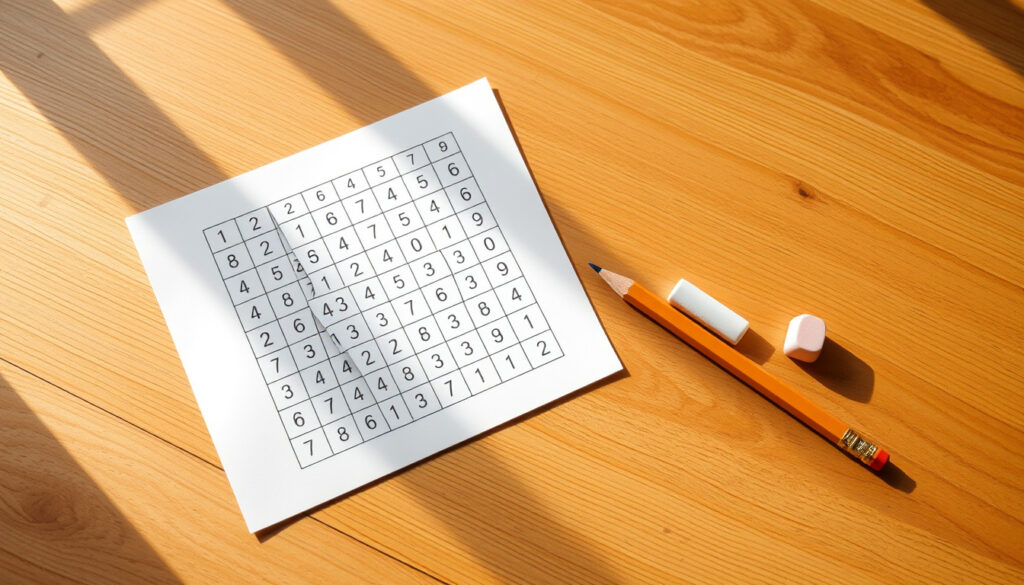
Sudoku is a logic puzzle that has captivated millions worldwide. At first glance, a 9×9 grid with some numbers already filled in can look intimidating. But the rules are simple, and once you understand them, any puzzle becomes a matter of patient deduction. This guide walks you through the basic rules, beginner-friendly techniques, and resources to start solving today.
Whether you are learning for the first time or helping a child get started, the core idea never changes: you place the numbers 1 through 9 so that no digit repeats in any row, column, or 3×3 box. No math, no guessing – just logic and pattern recognition.
Below you will find a complete breakdown of how to play Sudoku, from the fundamental constraints to advanced strategies that turn beginners into confident solvers.
What Are the Basic Rules of Sudoku?
- Sudoku requires zero math – only logic and pattern recognition.
- Most beginners start with the “scanning” method: look for rows or columns that already have many numbers filled in.
- The hardest Sudoku puzzles often require “pencil marks” (noting candidate numbers in cells) to solve efficiently.
- Online Sudoku platforms provide hints and auto‑check features, making them ideal for learning compared to paper puzzles.
- The difficulty lies not in complicated rules but in the logical deduction required – all solutions can be found through careful analysis without guessing.
| Fact | Detail |
|---|---|
| Grid size | 9×9 (81 cells) |
| Sub‑grid | 3×3 boxes (9 per puzzle) |
| Number range | 1 to 9 |
| Difficulty levels | Easy, Medium, Hard, Expert |
| Average solve time (beginner) | 10–30 minutes per puzzle |
| Popular online platforms | Sudoku.com, NYT Sudoku, Conceptis Puzzles |
How Do You Play Sudoku Step by Step for Beginners?
The best way to start a Sudoku puzzle is to identify rows, columns, and boxes that already have many numbers filled. This gives you the fewest possibilities and the clearest next moves.
What Is the Best Way to Start a Sudoku Puzzle?
Look for rows or columns that contain seven or eight numbers. The missing numbers are easy to spot. Then check the intersecting columns and boxes to see which of those missing numbers can be placed without breaking the rules. This is the process of elimination – the foundational technique for all solvers.
If a row has seven numbers filled and you know the two missing digits, check each empty cell’s column and 3×3 box. Often only one of the two missing digits is allowed in a given cell – that’s your answer.
How Do You Scan Rows and Columns?
Scanning means systematically moving your eyes across the grid to see where a particular number can go. Pick a number, say 5, and look at all the rows and columns that already contain a 5. Those lines “block” any empty cell in the same row or column. Within each 3×3 box, the 5 must go into a cell that is not blocked. This method quickly reveals placements.
What Is Crosshatching in Sudoku?
Crosshatching is an extension of scanning. You focus on one 3×3 box at a time and check which numbers are missing from it. Then you look at the rows and columns that intersect that box. If a row outside the box already contains a particular number, that number cannot appear in that row inside the box. By crossing out rows and columns, you narrow down where a number must go. Crosshatching is one of the most powerful techniques for beginners.
How to Solve Hard Sudoku Puzzles Like a Genius?
Once you are comfortable with scanning and crosshatching, harder puzzles require more advanced logic. The core idea remains the same – eliminate possibilities – but you need to keep track of multiple candidates per cell.
How Do You Use Pencil Marks Effectively?
In hard puzzles, you cannot rely on obvious placements. Write small numbers (candidates) in each empty cell representing all the digits that could possibly go there. After pencil‑marking the entire grid, you look for patterns. For instance, if two cells in the same row share the same two candidates and no other cell in that row contains them, those two candidates can be removed from the rest of the row. This is called a “naked pair.”
What Is the X‑Wing Technique in Sudoku?
The X‑Wing technique is a pattern‑based elimination strategy used in harder puzzles. It occurs when the same candidate number appears in exactly two rows and two columns, forming a rectangle. If that candidate can only be placed in those two positions in each row, then the candidate cannot appear elsewhere in those two columns. Recognizing X‑Wings allows you to eliminate possibilities systematically.
Without pencil marks, advanced patterns like X‑Wing or hidden pairs are nearly impossible to spot. Most expert solvers pencil‑mark every empty cell before applying advanced logic.
How to Play Sudoku Online and for Kids?
Digital platforms have made Sudoku more accessible than ever. You can play for free, get automatic hints, and choose from different grid sizes.
Where Can I Play Sudoku Online for Free?
Popular websites like Sudoku.com offer free puzzles with adjustable difficulty. The New York Times also publishes a daily Sudoku with a clean interface. For a structured technique library, Conceptis Puzzles provides step‑by‑step examples. Many platforms include auto‑check features that highlight mistakes as you fill.
How to Play Sudoku 1‑6 (Junior Version)?
Sudoku 1‑6 uses a 6×6 grid with 2×3 boxes. The rules are identical: each row, column, and 2×3 box must contain the numbers 1‑6 exactly once. This smaller grid is perfect for children or anyone who wants a gentler introduction. The same scanning and crosshatching techniques work; you simply have fewer numbers to track.
How to Teach Sudoku to Children?
Start with a 4×4 grid using numbers 1‑4, then progress to 6×6. Use physical grids with tokens or colored markers. Explain the one‑rule idea: “No repeats in the row, column, or box.” Encourage the child to find obvious cells first. Online platforms with hints can keep frustration low.
Many beginners jump to guessing when they get stuck. Remind children (and adults) that every cell can be solved through logical deduction. Guessing often leads to contradictions that waste time.
What Is the Step‑by‑Step Process to Solve a Sudoku Puzzle?
- Look at the grid and identify rows, columns, and 3×3 boxes with the most numbers already filled.
- Use scanning to fill in obvious cells where only one number is possible.
- Apply crosshatching: pick a missing number and scan its row, column, and box to see where it must go.
- If stuck, start pencil‑marking candidate numbers for empty cells.
- Use elimination logic (e.g., naked/hidden pairs) to reduce candidates.
- Repeat steps 2‑5 until the grid is complete or you need advanced techniques (X‑Wing, Swordfish).
What Do We Know for Sure About Sudoku Strategy?
| Established information | What remains unclear |
|---|---|
| The rules of Sudoku are fixed (1 number per row, column, and 3×3 box). | There is no single “best” solving strategy; it depends on personal style and puzzle difficulty. |
| Scanning is the universally recommended first technique. | Online platforms may have slight variations in difficulty rating scales. |
| Pencil marks are essential for hard puzzles. | The exact solve time varies widely; there is no fixed “average” for beginners. |
Where Did Sudoku Come From and Why Is It So Popular?
Sudoku gained global popularity in the early 2000s after being popularized by the Japanese puzzle publisher Nikoli. It is a logic‑based combinatorial number‑placement puzzle. With digital platforms, Sudoku remains one of the most accessible brain‑training games for all ages. The 2025 landscape includes AI‑powered hints and social features that keep the game fresh.
Experts agree that beginners should focus on scanning and crosshatching before moving to advanced techniques. The key is practice and pattern recognition. For many, the appeal lies in the quiet satisfaction of systematic deduction.
Where Can I Find Reliable Sudoku Instructions?
Several authoritative sources provide clear, verified instructions for beginners and advanced players.
“Sudoku is played on a grid of 9 x 9 spaces. Within the rows and columns are 9 ‘squares’ (made up of 3 x 3 spaces). Rule 1: Use Numbers 1-9 exactly once per row, column, and square.”
— Sudoku.com
“The goal is to fill in each of the cells with a number from one through nine. The digits must be placed so that each appears only once per row, per column, and per 3×3 box.”
— New York Times (2023)
“The rule itself is very simple. Fill all empty boxes with a number 1-9 so that no number repeats in the row, column, or boxes.”
— Reddit r/sudoku community
For visual learners, the Sudoku Guy YouTube playlist (Lessons 1‑12) offers a structured, step‑by‑step tutorial. The Reddit Sudoku community is a good place to ask questions and share solving experiences.
What’s the Best Way to Start Playing Sudoku?
The simplest route is to play a free online game at Sudoku.com or start with the How to Solve a Rubik’s Cube: Beginner Guide for another logic‑based challenge. You can also download a beginner Sudoku PDF for offline practice. After you are comfortable with scanning and crosshatching, try the daily Sudoku from the New York Times. If you enjoy brain‑training games, explore our Top 5 Brain Training Games for 2025 for more puzzles like Sudoku.
Frequently Asked Questions
How to play Sudoku like a genius?
“Genius” play usually refers to using advanced logic techniques like X‑Wing, Swordfish, and forcing chains. Start with scanning and crosshatching, then learn these patterns through practice and online tutorials.
How to play Sudoku 1‑6?
Sudoku 1‑6 uses a 6×6 grid with 2×3 boxes. The same rules apply: each row, column, and 2×3 box must contain the numbers 1‑6 exactly once. It is an excellent variant for kids and beginners.
How to play Sudoku for beginners PDF?
You can find free downloadable PDFs by searching “Sudoku for beginners PDF”. These typically include a rules page and several easy puzzles. Many educational sites and puzzle publishers offer them for free.
How to play Sudoku video?
The “Sudoku Guy” YouTube playlist is highly recommended for beginners. It covers lessons 1 through 12, teaching everything from basic rules to intermediate techniques in a visual, step‑by‑step format.
How to play Sudoku 3×3?
Standard Sudoku uses a 9×9 grid made of 9 smaller 3×3 boxes. The term “3×3” often refers to the small boxes inside the main grid. So playing “Sudoku 3×3” is just standard Sudoku. Some sources may use it for mini 3×3 puzzles, but that is rare.
Can I play Sudoku without guessing?
Yes. Every correctly constructed Sudoku puzzle has a unique solution that can be reached through pure logic. Guessing is never required, though it may sometimes be faster for very hard puzzles.
What is the difference between easy and hard Sudoku?
Easy puzzles have many given numbers, so scanning and crosshatching work quickly. Hard puzzles have fewer givens and require pencil‑marking and advanced patterns like naked pairs or X‑Wing.
More related posts
 Oona Chaplin – Biography, Game of Thrones Role and Upcoming Avatar Movie
 Tesco Opening Times Today – Check Local Store Hours Guide
 Brooks Adrenaline GTS 23 – Expert Review and Comparison
 Shea Lacey – Age, Height, Stats & Family Background
 Jude Riordan – Age, Family, and TV Roles
 Lewis Strictly – Age Family Emmerdale & Billy Elliot Career
 Olympique de Mar eille v PSG Timeline – Full Head-to-Head Record
 Current Inflation Rate UK – Steady at 3.0% CPI Feb 2026