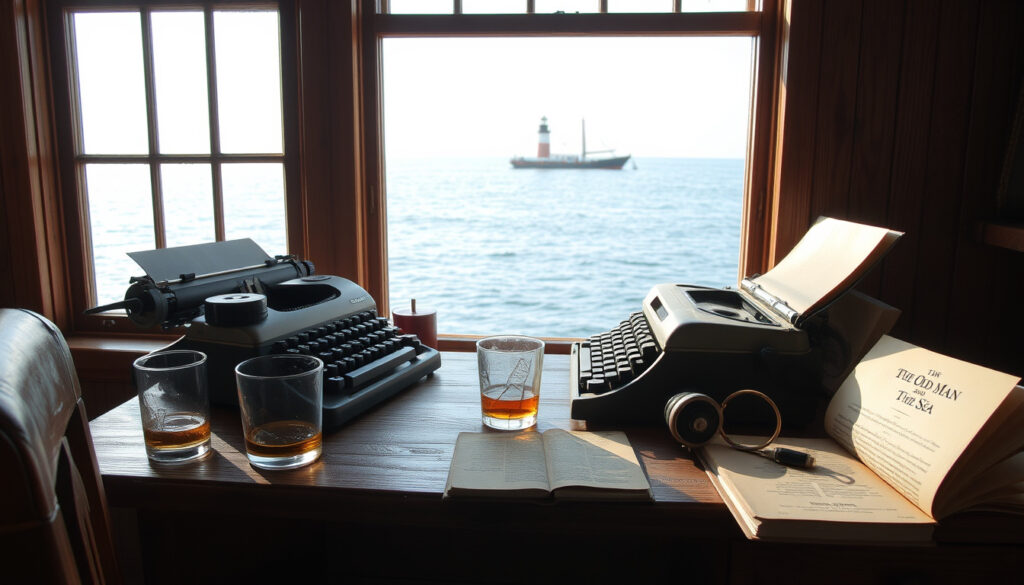
Ernest Hemingway – Biography, Books and Writing Style Guide
Few American writers have shaped modern literature as profoundly as Ernest Hemingway. Known for his sparse, muscular prose and an adventurous life that matched his fiction, Hemingway remains a towering figure in 20th-century culture. His work, from the disillusioned expatriates of The Sun Also Rises to the epic struggle of The Old Man and the Sea, continues to be read, studied, and debated more than six decades after his death.
Hemingway’s influence extends beyond his novels. For readers and writers, his approach to storytelling—lean, direct, and loaded with unspoken meaning—offered a radical break from the elaborate prose of earlier eras. But his legacy is inseparable from his turbulent life: a youth shaped by war, a career marked by global travel and adventure, and a tragic end that has taken on its own mythology.
Who Is Ernest Hemingway? A Brief Biography
July 21, 1899 – Oak Park, Illinois, USA
July 2, 1961 (aged 61) – Ketchum, Idaho, USA (self-inflicted gunshot)
Nobel Prize in Literature (1954) and Pulitzer Prize for Fiction (1953)
The Old Man and the Sea, A Farewell to Arms, The Sun Also Rises
Key Insights into Hemingway’s Life and Work
- Hemingway’s ‘iceberg theory’ redefined modern prose by omitting everything the reader already knows.
- He was an ambulance driver in WWI and a war correspondent in the Spanish Civil War and WWII, experiences that deeply shaped his anti-war themes.
- Despite his macho public image, Hemingway struggled with depression, alcoholism, and mental illness, ending his life just as his father had.
- His works have been adapted into more than 20 films, and his home in Key West remains a major tourist attraction.
- He lived in Paris during the 1920s as part of the expatriate “Lost Generation,” a community that included F. Scott Fitzgerald and Gertrude Stein.
- After two serious plane crashes in Africa in 1954, he suffered lasting pain and ill health, and was hospitalized for anxiety and depression.
- His spare literary style owes a significant debt to his early years as a journalist.
| Fact | Detail |
|---|---|
| Full Name | Ernest Miller Hemingway |
| Birth – Death | July 21, 1899 – July 2, 1961 |
| Occupation | Novelist, short-story writer, journalist |
| Notable Awards | Nobel Prize (1954), Pulitzer (1953) |
| Number of Wives | 4 (Hadley, Pauline, Martha, Mary) |
| Children | 3 (Jack, Patrick, Gregory) |
| Military Service | WWI ambulance driver, WWII war correspondent |
| Famous Works | The Old Man and the Sea, A Farewell to Arms, For Whom the Bell Tolls, The Sun Also Rises |
What Are Ernest Hemingway’s Most Famous Books and Stories?
Hemingway’s reputation rests on a relatively small body of work, but its impact has been immense. His debut novel, The Sun Also Rises (1926), established him as the voice of the post-World War I generation. The novel follows a group of American and British expatriates traveling from Paris to Pamplona and captures the profound disillusionment felt by many after the war. As Britannica notes, it remains closely associated with the sense of aimlessness among the “Lost Generation.”
A Farewell to Arms (1929) drew on his own experiences as an ambulance driver on the Italian front, weaving together themes of war, love, and loss. It is widely regarded as one of the finest war novels in the English language.
Set during the Spanish Civil War, For Whom the Bell Tolls (1940) tells the story of an American volunteer fighting with republican guerrillas. It explores themes of sacrifice, duty, and the futility of war.
The Old Man and the Sea
Perhaps his most beloved work, The Old Man and the Sea (1952), tells the simple, powerful story of an aging Cuban fisherman named Santiago and his battle with a giant marlin. The novella won the Pulitzer Prize for Fiction in 1953 and was a key factor in his receiving the Nobel Prize in Literature the following year. The Nobel committee praised him “for his mastery of the art of narrative.”
Hemingway’s posthumously published memoir, A Moveable Feast, offers a more intimate look at his years as a struggling writer in Paris during the 1920s.
Hemingway famously rewrote the ending of A Farewell to Arms 39 times. When asked what had been the hardest part, he replied: “Getting the words right.” This commitment to precision is the foundation of his minimalist style.
What Was Ernest Hemingway’s Unique Writing Style?
Hemingway’s prose is instantly recognizable. It is economical, direct, and stripped down, relying on short sentences and concrete nouns. He avoided elaborate descriptions and authorial commentary, letting the dialogue and action carry the story’s emotional weight.
The Iceberg Theory
This deliberate restraint is the foundation of what is commonly called the “Iceberg Theory,” or the theory of omission. Hemingway believed that if a writer truly understood his subject, he could leave out a great deal, and the omitted parts would strengthen the story. The deeper meaning, he argued, should not be evident on the surface but should shine through implicitly in what is left unsaid.
The Influence of Journalism
Critics and biographers have long linked his style to his early work as a journalist. Newspapers forced him to write clearly and concisely, distilling complex events into brief, factual reports. His fiction retains this discipline: every word must earn its place on the page. His work is also seen as a reaction to the collapse of older literary conventions after World War I.
How Did Ernest Hemingway Die? The Circumstances and Legacy
Ernest Hemingway died by suicide on July 2, 1961, at his home in Ketchum, Idaho, using a shotgun. He was 61 years old. In the years leading up to his death, he had suffered from severe physical and mental health problems, including depression and anxiety, for which he was hospitalized and treated with electroconvulsive therapy.
His father had also died by suicide, a fact that has led many to reflect on the family’s history of mental illness. The novelist was also plagued by physical ailments following two serious plane crashes in Africa in 1954, which left him with lasting pain.
Uncertainty and Debate
While the official cause of death is well established, certain aspects of his final years remain debated. The exact role the FBI’s surveillance may have played in his declining mental health remains unclear, and some conspiracy theories suggest he was not alone at the time of death, though official reports confirm no foul play. The degree to which his alcoholism contributed to his final depressive episode is also not fully documented.
Hemingway was admitted to the Mayo Clinic for treatment of severe depression in 1960 and 1961. He received electroconvulsive therapy, which some biographers argue may have damaged his memory and worsened his ability to write.
Where Did Ernest Hemingway Live? A Life on the Move
Hemingway’s identity was shaped as much by the places he lived as by the books he wrote. After growing up in Oak Park, Illinois, he moved to Paris in the 1920s, joining a circle of expatriate artists and writers that included Gertrude Stein and F. Scott Fitzgerald. This period, later chronicled in A Moveable Feast, was one of immense creative ferment.
He later settled in Key West, Florida, where his house is now a museum and a major tourist attraction. He also spent long periods in Cuba, where he wrote much of The Old Man and the Sea. After his health deteriorated, he moved to Ketchum, Idaho, where he lived until his death. He is buried in the Ketchum Cemetery.
Did Hemingway Win the Nobel Prize? Awards and Honors
Yes, Ernest Hemingway was awarded the Nobel Prize in Literature in 1954. The Swedish Academy cited his “mastery of the art of narrative, most recently demonstrated in The Old Man and the Sea, and for the influence that he has exerted on contemporary style.” The book had won the Pulitzer Prize for Fiction the year prior. According to Britannica, his style was “probably the most widely imitated” of the 20th century.
Ernest Hemingway Life Timeline
- 1899 – Born in Oak Park, Illinois
- 1918 – Wounded while serving as an ambulance driver in WWI
- 1921 – Marries Hadley Richardson; moves to Paris; joins expatriate community
- 1926 – Publishes The Sun Also Rises
- 1929 – Publishes A Farewell to Arms
- 1940 – Publishes For Whom the Bell Tolls
- 1952 – Publishes The Old Man and the Sea
- 1953 – Wins Pulitzer Prize
- 1954 – Awarded Nobel Prize in Literature
- 1961 – Dies by suicide in Ketchum, Idaho
What Is Certain and Uncertain About Hemingway’s Death?
| Established Information | Information That Remains Unclear |
|---|---|
| Hemingway died of a self-inflicted gunshot wound on July 2, 1961. | The exact role the FBI’s surveillance may have played in his declining mental health remains debated. |
| He had a history of depression and was treated with electroconvulsive therapy. | Some theories suggest he was not alone at the time of death, but official reports confirm no foul play. |
| His father also died by suicide. | The degree to which his alcoholism contributed to his final depressive episode is not fully documented. |
What Is Hemingway’s Enduring Significance?
Hemingway’s legacy rests on more than his adventurous life. His minimalist prose shaped generations of writers, from Raymond Carver to Chuck Palahniuk, and his work defined the “Lost Generation” ethos after World War I. His subjects—war, courage, loss, masculinity, and endurance—combined with his distinctive style to create a body of work that remains foundational. He became a cultural figure whose public image of toughness and adventure helped shape how later generations remembered him. Writers who came after either emulated or reacted against his style, a testament to its enduring power.
Sources and Key Quotes
“A man can be destroyed but not defeated.”
— Ernest Hemingway, The Old Man and the Sea
“The world breaks everyone and afterward many are strong at the broken places.”
— Ernest Hemingway, A Farewell to Arms
“For his mastery of the art of narrative, most recently demonstrated in The Old Man and the Sea, and for the influence that he has exerted on contemporary style.”
— Nobel Prize Committee (1954)
Summary: Why Hemingway Still Matters
Ernest Hemingway left behind a literary legacy that few have matched. His innovative use of language, his exploration of universal themes, and his remarkable, tumultuous life have made him an enduring subject of study and fascination. For readers new to his work, beginning with The Old Man and the Sea offers a direct entry into his genius. Those interested in the cultural landscape of the 20th century might find similar resonance in the career of Martin Scorsese – Complete Career and Life Guide, whose films, like Hemingway’s novels, explore themes of masculinity, violence, and moral complexity. Alternatively, the story of James Stewart – Hollywood Icon and War Hero’s Full Biography parallels Hemingway’s own journey through war and public life. His influence on modern literature is immeasurable, and his works remain essential reading.
Frequently Asked Questions
How many books did Ernest Hemingway write?
Hemingway published seven novels, six short-story collections, and two nonfiction works during his lifetime. An additional three novels and three collections were published posthumously.
Why is Hemingway’s writing style called the iceberg theory?
The iceberg theory suggests that the deeper meaning of a story should shine through implicitly rather than being explained outright. Hemingway believed the writer should omit anything the reader already knows.
Was Ernest Hemingway friends with F. Scott Fitzgerald?
Yes, they were friends in 1920s Paris, though their friendship later soured. Hemingway wrote about Fitzgerald in his memoir A Moveable Feast.
Did Ernest Hemingway serve in the military?
He served as an ambulance driver for the Red Cross in WWI and later as a war correspondent for the U.S. Army during WWII. He was not a regular soldier.
What is Hemingway’s most popular book?
The Old Man and the Sea is often considered his most famous work, winning the Pulitzer Prize and contributing to his Nobel.
How many times was Hemingway married?
He was married four times: to Hadley Richardson, Pauline Pfeiffer, Martha Gellhorn, and Mary Welsh.
Did Hemingway have children?
He had three sons: Jack, Patrick, and Gregory.
Where is Hemingway buried?
He is buried in the Ketchum Cemetery in Ketchum, Idaho.
What is the Lost Generation?
The Lost Generation refers to the generation that came of age during World War I. The term was popularized by Gertrude Stein and is closely associated with the expatriate writers of 1920s Paris, including Hemingway.
More related posts
 Percy Jackson – Complete Guide to Books Movies and Series
 Lucy Briers – Biography, Age, Husband and Downton Abbey Role
 Matt Berry – Biography, TV Shows, Music and Distinctive Voice
 David Jonsson – Biography, Age, Movies and TV Shows
 John Nettles – Biography, Health Update and Life in 2025
 Ryan Garcia – Record, Suspension, and Next Fight in 2025
 Coventry City F.C. Players – 2024/25 Squad Numbers and Stats