Gustav Klimt – Biography Paintings Death and Complete Guide
Gustav Klimt remains one of the most recognisable figures in modern art, a painter who draped his subjects in gold and pattern while challenging the boundaries of acceptable imagery. Born in 1862 in a small town near Vienna, he rose from a background of decorative commissions to lead a rebellious group of artists who wanted to tear down the old rules. His work—especially The Kiss—continues to draw millions of visitors and inspire new generations of creators.
Klimt’s life was sort but intense. He never married, yet fathered numerous children, and he died suddenly in 1918, leaving behind a body of work that mixes eroticism, symbolism, and sheer decorative brilliance. The story of his life and art offers a window into Vienna at a time of seismic cultural change.
Who Was Gustav Klimt? Biography and Artistic Legacy
Gustav Klimt was an Austrian symbolist painter, a founding leader of the Vienna Secession, and the creator of some of the most expensive and beloved paintings of the twentieth century. His style evolved from classical realism to a highly ornamental, gold-laden phase that remains his trademark.
Key Insights
- Klimt was a founding member of the Vienna Secession, a radical art movement that rejected academic traditions.
- His“Golden Phase” produced some of his most iconic works, using gold leaf inspired by Byzantine mosaics.
- Controversy surrounded his paintings due to erotic themes, leading to accusations of pornography.
- Klimt never married but had numerous models and fathered at least fourteen acknowledged children.
- His sudden death in 1918 likely resulted from a stroke exacerbated by the Spanish flu pandemic.
- The portrait of Adele Bloch‑Bauer I sold for $135 million in 2006, one of the highest prices ever paid for a painting.
| Category | Detail |
|---|---|
| Birth | 14 July 1862, Baumgarten, Austrian Empire |
| Death | 6 February 1918, Vienna, Austria (age 55) |
| Nationality | Austrian |
| Movement | Symbolism, Vienna Secession, Art Nouveau |
| Medium | Oil, gold leaf, fresco |
| Famous works | Over 200 known paintings (plus thousands of drawings) |
| Top museum | Belvedere Palace, Vienna (houses The Kiss) |
Born the second of seven children, Klimt trained at the Vienna School of Applied Arts. He began his career painting murals in a classical‑realist style for public buildings such as the Burgtheater and the Kunsthistorisches Museum. In 1897 he helped found the Vienna Secession, becoming its first president. The Secession was a group that broke away from the conservative Vienna art establishment to promote modern, international art. Klimt also helped launch its journal, Ver Sacrum.
How Did Gustav Klimt Die? Examining the Cause and Circumstances
Klimt suffered a stroke in January 1918 that left him partially paralysed. He died on 6 February 1918 in Vienna. The immediate cause is not entirely settled: some sources say he died from the stroke itself, while others list pneumonia or flu following the stroke. Given the timing—the Spanish flu pandemic was raging—everal historians believe that illness after the stroke was what actually killed him.
Sources differ on the medical chain. The Art Story and the Klimt Foundation note that the stroke led to partial paralysis, and that pneumonia or flu after the stroke was likely fatal. Kallir Research also points to this ambiguity. The precise cause is still debated among biographers.
The Stroke and Its Aftermath
According to the Klimt Foundation, Klimt suffered a stroke in early 1918 and was partially paralysed. He died on 6 February. The Art Story states that he developed pneumonia after the stroke, which became the immediate cause of death. Britannica and other reliable sources also mention a “pneumonia/flu” complication. Because the Spanish flu epidemic was at its peak in Vienna at the time, it is plausible that Klimt contracted the virus while weakened.
The Spanish flu killed millions worldwide in 1918–1919. Vienna was not spared. Klimt’s death in early February 1918 falls within the timeline of the pandemic, but no source definitively links his death to the Spanish flu. The uncertainty is part of the historical record.
What Are Gustav Klimt’s Most Famous Paintings?
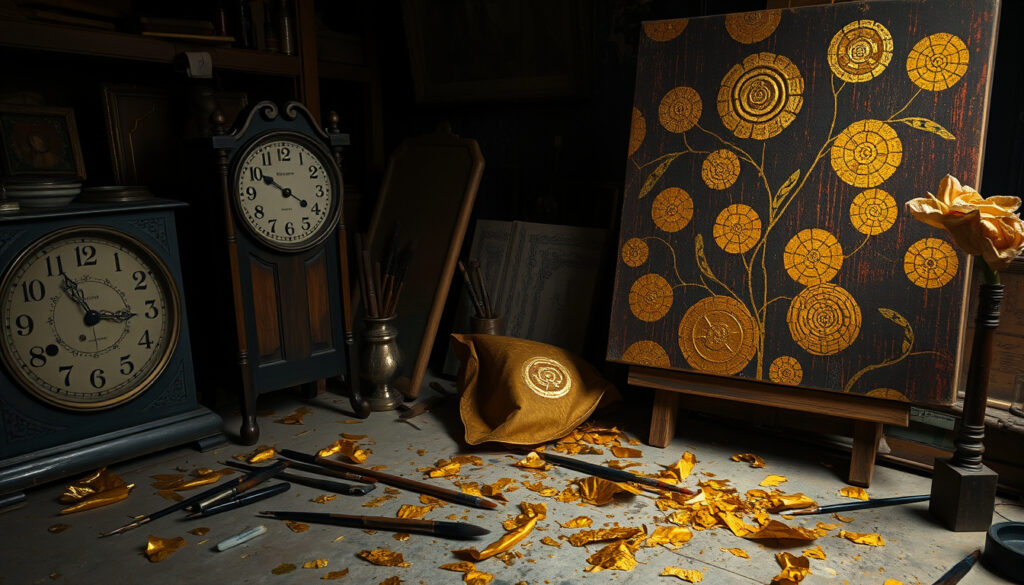
Klimt’s best-known works come from his “Golden Phase” (roughly 1898–1908), when he used gold, silver, and platinum leaf to create shimmering, mosaic‑like surfaces. The most famous of all is The Kiss, a nearly life‑size painting of a couple embracing in a field of gold. It was completed in 1907–1908 and is now at the Belvedere Museum in Vienna.
The Kiss and Its Meaning
The Kiss depicts a man and woman locked in an intimate embrace, surrounded by ornament. The man’s robe is composed of black‑and‑white rectangles, while the woman’s dress is filled with floral patterns. Both figures are covered in gold leaf, making the painting glow. The meaning is ambiguous: it can be read as a romantic union, a spiritual merging, or a celebration of erotic love. Klimt himself did not explain it, leaving it open to interpretation.
Other major works from the Golden Phase include Pallas Athene (1898), Judith I (1901), and the Portrait of Adele Bloch‑Bauer I (1907). The latter, often called “Woman in Gold,” sold for $135 million in 2006. Klimt was influenced by Japanese art, Byzantine mosaics, and the symbolism of life cycles. His mature style is characterised by ornamentation, flat decorative surfaces, erotic symbolism, and extensive use of gold leaf.
Where Can You See Gustav Klimt’s Art? Museums and Collections
Vienna is the centre of Klimt’s universe. The Belvedere Palace holds The Kiss and many other paintings. The Leopold Museum and the Albertina also have significant Klimt collections. The Kunsthistorisches Museum displays the murals he painted early in his career. Outside Vienna, Klimt’s works appear in major institutions such as MoMA in New York (through loans) and the Tate. The Klimt Villa, where he lived and worked, is open to visitors in Vienna.
The Belvedere’s permanent collection includes the largest gathering of Klimt’s paintings. Check the museum’s website for current exhibitions and ticket information. Attersee, where he spent summers painting landscapes, is also a pilgrimage site for fans.
Gustav Klimt in Modern Culture: Books, LEGO, and More
Klimt’s influence extends far beyond museum walls. His imagery appears on fashion, home decor, and even LEGO bricks. In 2022, LEGO released a set inspired by The Kiss (set #31208) as part of its Art series. It is a mosaic-style build that allows collectors to recreate the painting in brick form. Books on Klimt are plentiful; the most recommended is Gustav Klimt: The Complete Paintings by Tobias G. Natter, which offers a scholarly catalogue raisonné. For a lighter biography, Klimt: A Life by Frank Whitford is widely praised.
Klimt’s works have also been the subject of documentaries and films, including the 2015 movie Woman in Gold, which tells the story of the restitution of the Bloch‑Bauer portrait. His art continues to be a touchstone for contemporary artists and designers.
Gustav Klimt’s Life: A Timeline of Key Events
- 1862: Born in Baumgarten near Vienna.
- 1883–1892: Works with his brother Ernst and Franz Matsch on murals and decorative projects.
- 1897: Co‑founds the Vienna Secession and becomes its first president.
- 1902: Completes the Beethoven Frieze for the Secession building.
- 1903: Travels to Ravenna and sees Byzantine mosaics, inspiring the “Golden Phase.”
- 1907: Paints Portrait of Adele Bloch‑Bauer I (later known as Woman in Gold).
- 1908: Exhibits The Kiss at the Kunstschau; it becomes an instant success.
- 1918: Suffers a stroke, dies from complications (pneumonia/Spanish flu) on 6 February.
What Is Known and What Remains Uncertain About Klimt
Established Information
- Born 14 July 1862 and died 6 February 1918.
- Founder of the Vienna Secession.
- Painted The Kiss in 1907–1908.
- Never married, but had numerous relationships and at least 14 acknowledged children.
Information That Remains Unclear
- Exact cause of death: stroke or Spanish flu? Most sources cite stroke followed by pneumonia/flu.
- The precise number of his illegitimate children is not fully documented.
- Some works, such as Portrait of Adele Bloch‑Bauer I, were subject to lengthy restitution cases after Nazi looting.
Understanding Klimt’s Art: Themes and Historical Context
Klimt’s work is deeply tied to the intellectual ferment of fin‑de‑siècle Vienna. Freudian ideas about sexuality, the breakdown of bourgeois morality, and a fascination with the unconscious all coloured his imagery. He used the female form not merely as a subject but as a vehicle for exploring life, death, and desire. His flat, decorative surfaces—influenced by Japanese ukiyo‑e prints—rejected the naturalism of academic painting and pushed art toward abstraction.
The Vienna Secession itself was part of a broader modernist movement that included architecture, design, and music. Klimt’s work inspired later Expressionists such as Egon Schiele and Oskar Kokoschka. His legacy persists not only in art history books but in the way contemporary culture uses pattern, gold, and sensuality.
Key Sources and Quotes on Gustav Klimt
“Art is a line around your thoughts.” — Gustav Klimt
“I am less interested in myself as a subject for painting than I am in other people, above all women.” — Gustav Klimt
Among the most authoritative sources on Klimt are the Britannica biography, the Wikipedia entry, and the Belvedere Museum’s website. Scholarly catalogues such as Gustav Klimt: The Complete Paintings by Tobias G. Natter provide deep analysis. For those interested in the legal and historical context of his looted works, the restitution story of the Bloch‑Bauer portrait is documented by multiple archives.
Gustav Klimt: A Lasting Legacy
More than a century after his death, Gustav Klimt remains a household name. His gold‑drenched paintings are symbols of romantic love, artistic rebellion, and the sheer power of decorative beauty. Whether you encounter The Kiss in a museum, on a LEGO box, or as a fashion print, Klimt’s vision endures. For readers interested in another contemporary artist who pushes boundaries, see the profile on Jenny Saville Artist – Biography, Paintings, and 2025 Exhibition at Angle Journal.
Frequently Asked Questions
How did Gustav Klimt die?
Klimt died on 6 February 1918 after suffering a stroke that led to pneumonia, possibly compounded by the Spanish flu. He was 55.
Is there a Gustav Klimt LEGO set?
Yes, a LEGO Ideas set titled “The Kiss” (set #31208) was released in 2022, featuring a mosaic of Klimt’s famous painting. It is part of the LEGO Art series.
What is the best book about Gustav Klimt?
Many recommend Gustav Klimt: The Complete Paintings by Tobias G. Natter. For a biography, Klimt: A Life by Frank Whitford is a solid choice.
Where are Gustav Klimt’s paintings displayed?
The Belvedere Palace in Vienna holds The Kiss. Other locations: Leopold Museum, Albertina, and the Kunsthistorisches Museum in Vienna; also MoMA in New York via loans.
What is Gustav Klimt’s style?
Klimt’s style is symbolic and erotic, using gold leaf, intricate patterns, and a fusion of naturalism with decorative abstraction. He is associated with Symbolism and the Vienna Secession.
Did Gustav Klimt have children?
He never married but fathered at least 14 children, many with models and companions. The exact number is not fully documented.
What was the Vienna Secession?
A group of artists who broke away from the conservative Vienna art establishment in 1897 to promote modern, international art. Klimt was its first president.
Why is Klimt’s art so valuable?
His unique use of gold leaf, erotic symbolism, and historical significance drive high prices. Portrait of Adele Bloch‑Bauer I sold for $135 million in 2006.
What is the meaning of The Kiss?
Klimt never explained it. It is often read as a romantic union, a spiritual merging, or a celebration of erotic love. The ambiguity adds to its appeal.
Did Klimt travel?
He spent many summers at Attersee painting landscapes. He also travelled to Ravenna (Italy) in 1903, where Byzantine mosaics inspired his “Golden Phase.”
More related posts
 Ann Ming – The Mother Who Changed the Double Jeopardy Law
 Big Time Rush – Complete 2025 Guide on Members Tours and Music
 British Gas Meter Reading – Step-by-Step Guide to Accurate Billing
 Shane Richie – Biography, Net Worth, and Career Highlights
 Black Cardigan – Cropped, Long and Chunky Buying Guide
 Paula Patton – Biography, Net Worth and Personal Life
 Frank Abagnale Jr – True Story, Crimes, Family & Net Worth
 Joe Bartolozzi – Bio, Age, Content, and Online Presence